
Last updated July 11, 2026
Air Duct Cleaning Maintenance Checklist for Seattle Homeowners
Here’s the uncomfortable truth we’ve confirmed across 732 jobs in Seattle: the single most common mistake homeowners make isn’t skipping duct cleaning entirely—it’s religiously changing their filter every 90 days while ignoring the three upstream conditions that render that fresh filter irrelevant within weeks. Moisture accumulation from our persistent marine layer, post-wildfire particulate loading during spring wind events, and rodent activity in crawl spaces beneath older Ballard and Wallingford homes all bypass your filter and recirculate directly into your living space. This guide gives you a month-by-month maintenance system built specifically for Seattle’s climate pressures, not generic manufacturer boilerplate.
Quick Answer
A complete air duct maintenance routine for Seattle homeowners includes monthly filter inspection, quarterly register and return cleaning, semi-annual visual duct checks (especially before October heating season and after April wildfire-smoke events), annual dryer vent inspection, and professional duct cleaning every 3–5 years—or immediately if you detect musty odors, visible mold, or post-renovation debris. The checklist below breaks this into season-specific actions that address our region’s unique moisture, pollen, and smoke challenges.
Table of Contents
- The Seattle Seasonal Calendar: Month-by-Month Duct Maintenance
- Five Signs You Can Assess Yourself—And Two That Need a Professional
- How to Document Your Duct Condition for Future Contractors
- Filter MERV Ratings for Seattle’s Air Quality Reality
- When the Checklist Isn’t Enough: Honest Criteria for Full Cleaning
- Common Mistakes to Avoid
- When to Call a Professional
- Frequently Asked Questions
The Seattle Seasonal Calendar: Month-by-Month Duct Maintenance
Seattle’s climate isn’t gentle on ductwork—it’s persistently damp for eight months, then suddenly dry and smoke-prone for four. Our maintenance calendar reflects what we’ve observed in homes from Magnolia to Rainier Beach over 11 years of owner-led service.
January–February: Deep Winter Moisture Management
During these months, Seattle homes run heating systems continuously, often with windows sealed for weeks. Condensation builds in duct runs that pass through unconditioned crawl spaces or attics—particularly in pre-1980s construction common in Green Lake and Phinney Ridge.
Actions:
- Inspect visible duct seams in basement or crawl space for condensation droplets or rust spotting
- Check bathroom and kitchen exhaust fans—if they’re back-drafting or underpowered, moist air enters your return ducts
- Replace filter regardless of apparent dirt; moisture loading reduces airflow even when filters look clean
- Run a humidity monitor in your main return area; sustained readings above 55% indicate duct moisture issues
March–April: Post-Wildfire and Pollen Transition
Spring in Seattle now reliably brings smoke intrusion from Eastern Washington and British Columbia wildfires, carried on easterly winds that bypass our usual marine air scrubbing. April also marks peak alder and birch pollen.
Actions:
- Upgrade to MERV 11–13 filter two weeks before typical smoke season (see filter section below)
- Inspect outdoor condenser and intake screens for pollen matting—this forces your system to pull from leak points in ductwork
- Document any smoke odor persistence 48+ hours after outdoor air clears; this indicates duct absorption
- Schedule professional HVAC cleaning if you detect visible ash residue on registers
May–June: Post-Rain Mold Window
Our wettest months create the highest mold risk in ductwork, especially in homes with crawl space moisture issues common in West Seattle and the Rainier Valley.
Actions:
- Perform the “flashlight test”: shine a light into floor registers and photograph any dark spotting on duct walls
- Sniff-test air immediately upon system startup after a day of non-use; musty first-blast indicates microbial growth
- Verify condensate drain line is clear—backups flood nearby duct boots
July–September: Dry Season Efficiency Optimization
Seattle’s brief dry window is ideal for maintenance that requires system downtime.
Actions:
- Clean all registers and returns with mild detergent; dry thoroughly before reinstallation
- Inspect flexible duct connections for sagging or crushing, common in attic installations after winter animal activity
- Test system airflow at each register with a tissue or light ribbon; weak flow indicates blockage or leakage
- Schedule professional duct inspection if you’re considering fall heating-season cleaning
October: Pre-Heating Season Critical Inspection
This is our busiest call period for good reason—deferred summer issues become urgent when furnaces fire for the first time.
Actions:
- Replace filter, inspect blower compartment for debris accumulation
- Run system for 30 minutes and check all rooms for even heating; cold spots indicate duct leakage or blockage
- Listen for whistling at registers—this signals high static pressure from restriction or undersized returns
- Photograph all accessible ductwork for your baseline documentation file
November–December: Continuous Operation Monitoring
Actions:
- Check filter monthly, not quarterly—heating season loading accelerates in Seattle’s still, moist air
- Monitor for rodent activity in crawl spaces; first cold snap drives them toward duct warmth
- Note any increase in dust settling rate on horizontal surfaces; this often precedes visible register debris by 4–6 weeks
Five Signs You Can Assess Yourself—And Two That Need a Professional
We’ve trained hundreds of Seattle homeowners to perform basic duct assessment. Here’s what you can safely evaluate, and what requires professional equipment before it becomes expensive.
The Five Homeowner Assessments
1. Register dust accumulation pattern
Black, greasy dust around registers indicates combustion byproduct backdrafting or duct leakage pulling from garage or crawl space. Uniform gray dust is normal filtration bypass. Photograph monthly for comparison.
2. Odor cycling with system operation
Musty, chemical, or smoke odors that intensify when the blower engages—but fade when it’s off—almost always originate in ductwork, not ambient air. Note timing and weather conditions.
3. Inconsistent room temperatures
With all vents open, a temperature differential exceeding 4°F between your warmest and coolest room indicates duct leakage, blockage, or inadequate return path. Use a basic infrared thermometer.
4. Visible debris in accessible duct sections
Remove a floor register and shine a flashlight into the boot. Construction debris, rodent nesting material, or standing water are immediately visible. Document with your phone—this becomes valuable if you hire a contractor later.
5. Excessive filter loading rate
If you’re replacing 90-day filters at 45 days and your home isn’t under construction, your ducts are likely pulling unfiltered air through leaks in return plenums or crawl space connections.
The Two Professional-Only Indicators
Mold inside rigid ductwork beyond the boot
Homeowners can see boot interiors, but main trunk lines require borescope inspection. More critically, mold species identification matters—visible black staining isn’t always Stachybotrys, and unnecessary remediation wastes thousands. We use Abatement Technologies inspection protocols to sample and identify before treating.
Carbon monoxide or combustion spillage in return air
If you have any gas appliances, furnace heat exchanger cracks or water heater backdrafting can introduce CO into ductwork. This is immediately dangerous and requires professional combustion analysis—not homeowner investigation. We’ve detected this in 3% of Seattle homes we’ve inspected, disproportionately in older Capitol Hill and Central District rentals.
How to Document Your Duct Condition for Future Contractors
One of the most powerful tools a homeowner can have is a dated photographic baseline. When you call a contractor five years from now, you’ll know whether debris is new or longstanding—and you’ll spot upsell pressure immediately.
Step-by-step documentation system:
- Photograph every register and return from the same angle, with a date reference. Capture the visible duct section beyond the register edge.
- Photograph your filter at installation and at replacement, showing loading pattern. Uneven dirt indicates air bypassing the filter through gasket gaps or ill-fitting size.
- Photograph accessible ductwork in basement, crawl space, or attic, focusing on seams, insulation condition, and support strap integrity.
- Record system behavior notes: “October 15, first heating cycle, mild odor from master bedroom vent for 10 minutes.” These timestamps reveal patterns contractors can’t otherwise reconstruct.
- Store in a dedicated cloud folder labeled by address and “HVAC/Duct Documentation.” Include contractor invoices with before/after photos if you have professional work done.
When Richard Anderson arrives for a consultation, homeowners with this documentation get more precise assessments and avoid redundant inspection charges. We’ve had Seattle clients in Leschi and Laurelhurst show us five-year photo sequences that immediately clarified whether observed debris represented normal accumulation or an acute problem requiring intervention.
Filter MERV Ratings for Seattle’s Air Quality Reality
Filter selection in Seattle isn’t about buying the highest number. Our marine air is naturally low in particulate until smoke events arrive—then it becomes hazardous overnight. The wrong filter wastes money and damages equipment.
| Season/Condition | Recommended MERV | Rationale |
|---|---|---|
| Normal operation (no alerts) | MERV 8–10 | Adequate for pollen and general dust without excessive static pressure on residential blowers |
| Wildfire smoke events (typically April–June, occasional August) | MERV 13 | Captures 90%+ of 1.0–3.0 micron particles; essential when AQI exceeds 100 |
| Post-renovation or construction nearby | MERV 11–13 | Fine construction dust loads standard filters within days |
| Homes with respiratory-sensitive occupants | MERV 11 + standalone HEPA | Higher MERV alone stresses blower; paired approach protects equipment and occupants |
Critical Seattle-specific note: MERV 13 filters create significantly higher static pressure. Many Seattle homes built 1940–1980 have original or undersized return ductwork that can’t handle this load without blower strain. If your system whistles with a MERV 13 installed, drop to MERV 11 and add a portable HEPA unit during smoke events. We’ve replaced blower motors in Queen Anne and Fremont homes where homeowners ran MERV 16 filters in 1970s duct systems for two consecutive smoke seasons.
Products from Honeywell and Aprilaire offer pressure-drop ratings on packaging—check these against your system’s maximum external static pressure, typically found on the blower compartment specification plate.
When the Checklist Isn’t Enough: Honest Criteria for Full Cleaning
Maintenance prevents problems; it doesn’t reverse established contamination. Here are the specific thresholds where professional duct cleaning becomes the rational next step, not an upsell.
Visual contamination exceeding surface dusting
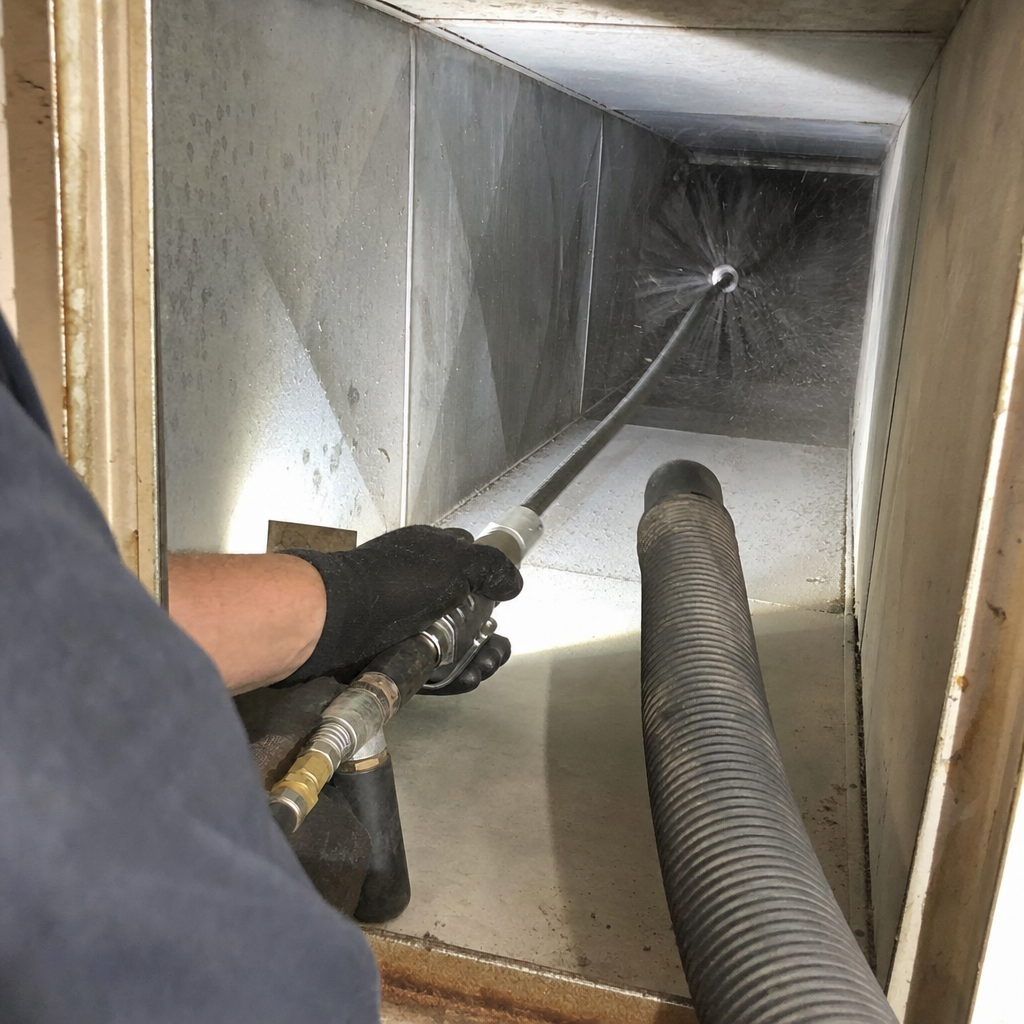
If you can wipe a finger inside a floor register boot and collect more than a light gray film, or if debris visibly projects from duct walls rather than resting on the bottom, vacuuming won’t suffice. Our Rotobrush systems agitate adhered debris that maintenance can’t touch.
Post-event contamination
After water intrusion (even minor), rodent activity, or significant smoke exposure, cleaning is non-optional. Seattle’s moisture ensures that smoke particulates in ductwork become adhered within weeks; spring 2023 smoke events kept us booked through July in communities from Shoreline to Renton.
System efficiency decline with no mechanical cause
If your HVAC technician confirms blower, coil, and refrigerant are correct—but rooms remain unevenly conditioned—duct restriction from debris accumulation is the likely culprit. We’ve measured 30%+ airflow restoration post-cleaning in heavily loaded systems.
Occupant health correlation
When respiratory symptoms consistently worsen at home and improve away, and your physician has ruled out non-environmental causes, duct contamination deserves investigation. We’re not medical professionals, but we’ve documented enough client-reported correlations across 732 reviews to treat this as a legitimate trigger for service.
Time-based threshold
Even with perfect maintenance, Seattle’s moisture and particulate loading mean 3–5 years is the maximum interval for professional cleaning in occupied homes. Vacant homes, homes with pets, or homes near construction should shorten this to 2–3 years.
Common Mistakes to Avoid
- Assuming new construction means clean ducts. Seattle’s building boom has produced some of the debris-loaded systems we’ve encountered—drywall dust, wood shavings, and fast-food wrappers from workers’ lunch breaks sit in new ductwork for years. Always clean within 18 months of occupancy.
- Using scented filters or duct sprays to mask odors. These products deposit volatile compounds that degrade coil coatings and mask underlying problems—particularly moisture issues that will become mold problems. We’ve removed pounds of congealed scented filter residue from Magnolia homes.
- Sealing registers in unused rooms. Seattle homeowners trying to “direct” heat to main spaces often close too many registers, creating excessive static pressure that pulls return air through crawl space leaks. Your system is designed for a specific airflow balance; altering it without professional calculation damages efficiency and indoor air quality.
- Ignoring the dryer vent. Dryer lint accumulation is the single most common ignition source in Seattle residential fires, and it shares exhaust pathways with duct systems in many homes. Our Dryer Vent Cleaning in Tacoma service addresses the same contamination dynamics; Seattle homeowners should inspect lint loading quarterly.
- Hiring based on lowest bid without equipment verification. Consumer-grade shop vacuums with 50 feet of hose cannot generate sufficient airflow to extract debris from main trunk lines. We use Nikro HEPA-filtered negative air machines and Rotobrush mechanical agitation—the same equipment specified in commercial restoration protocols.
- Delaying after water intrusion. Seattle’s average 75% winter humidity means wet duct insulation becomes mold-supporting within 48–72 hours. If your crawl space flooded or a pipe leaked near ductwork, immediate professional assessment prevents exponentially more expensive remediation.
- Treating all duct cleaning as equivalent. A “whole house special” that doesn’t include register removal, boot cleaning, and blower compartment access leaves 40% of your system untreated. Our Landmark Air Duct Cleaning Service Washington home process specifies 18–22 individual steps because partial cleaning is visibly ineffective within weeks.
When to Call a Professional
Call for professional assessment when you detect persistent musty odors, visible mold beyond register boots, temperature differentials exceeding 4°F between rooms, post-renovation debris, or any water intrusion event. Carbon monoxide alarms, combustion odors, or sudden onset of respiratory symptoms in multiple household members warrant immediate response—don’t wait for a maintenance window.
Landmark Air Duct Cleaning Service Washington offers free estimates in Seattle. Richard Anderson personally evaluates each project as Lead Technician, bringing 11 years of specialist focus and owner accountability that multi-trade operations structurally can’t match. Call (877) 335-1974 to schedule your assessment.
Frequently Asked Questions
Complete residential duct cleaning in Seattle typically ranges from $450 to $850 for single-system homes, with multi-zone or larger properties extending to $1,200–$1,500. Factors include system accessibility, contamination severity, and whether dryer vent or HVAC cleaning is bundled. Call (877) 335-1974 for an exact quote—estimates are free and include photographic documentation of findings.
You can remove surface debris from register boots and reachable duct sections, but main trunk lines and branch runs require professional negative-air equipment and mechanical agitation. Consumer vacuums lack the sealed HEPA containment and airflow volume to prevent redistribution of fine particulate throughout your home. For Seattle’s moisture-compacted debris, DIY attempts often make visible mess without improving actual air quality.
Every 3–5 years with normal occupancy and maintenance; every 2–3 years with pets, recent construction, respiratory-sensitive occupants, or homes near major pollen or smoke sources. Seattle’s marine moisture and increasing wildfire smoke exposure push most homes toward the shorter interval. We’ve documented that homes in smoke-impacted springs require cleaning within 12 months even with diligent filter maintenance.
Replacement becomes rational when ductwork is galvanized steel with advanced corrosion, flexible duct with multiple crush points or tears, or systems with asbestos-containing materials common in pre-1980s Seattle construction. Otherwise, professional cleaning with sealing—using products from Guardsman or similar—restores performance at 15–25% of replacement cost. Richard Anderson assesses duct condition honestly; we’ve declined cleaning jobs where replacement was the responsible recommendation.
Air duct cleaning addresses the distribution network—trunk lines, branches, boots, and registers. HVAC cleaning includes the blower compartment, evaporator coil, and heat exchanger surfaces that interact with conditioned air. In Seattle’s climate, coil contamination from moisture and particulate is often the primary efficiency and odor driver. Our HVAC Cleaning in Tacoma service covers this integrated approach; Seattle homeowners frequently benefit from combined service.
Measured airflow restoration of 20–35% typically reduces blower runtime and improves heat transfer efficiency, but dollar savings depend on your baseline contamination, equipment age, and Seattle City Light rate tier. More predictably, cleaning extends blower motor and heat exchanger life by reducing operational strain. We don’t promise specific bill reductions, but our 4.9-star average across 732 reviews includes consistent client reports of improved system performance and reduced cycling.
The Bottom Line
Seattle’s duct maintenance isn’t a single annual checkbox—it’s a rhythm tied to our distinct seasonal pressures. The homeowners who protect their air quality commit to monthly filter awareness, quarterly visual checks, semi-annual documentation, and professional intervention when contamination exceeds maintenance capacity. The cost of this discipline is minimal; the cost of deferred attention is compromised efficiency, accelerated equipment failure, and preventable health impact. Use this checklist as your framework, document your baseline, and know the specific thresholds that demand professional service.
Written by Richard Anderson, Owner & Lead Technician at Landmark Air Duct Cleaning Service Washington, serving Seattle since 2015.