
Last updated July 11, 2026
How to Hire a Air Duct Cleaning Contractor in Seattle: A Step-by-Step Guide
The Better Business Bureau has logged more complaints about duct cleaning bait-and-switch pricing than almost any other home service category — and the contractors running that play are disproportionately active in markets like Seattle, where homeowners feel genuine air quality anxiety from wildfire smoke season and persistent mold concerns. In this guide, you’ll learn the exact verification steps, phone-screening questions, and quote-reading skills that separate legitimate single-trade specialists from opportunistic add-on services. We’ve spent 11 years watching Seattle homeowners navigate this market, and the difference between a quality job and a costly disappointment usually comes down to what you verify before anyone sets foot in your home.
Quick Answer
To hire a reputable air duct cleaning contractor in Seattle, verify three credentials (NADCA membership, active Washington State contractor license, and liability insurance), ask eight specific screening questions by phone, and demand a written scope of work with fixed access points before booking. Expect to pay $400–$800 for a complete residential system in the Seattle market — quotes significantly below this range are a primary red flag for on-site upselling.
Table of Contents
- Why the Seattle Market Is Different
- The Three Credentials That Actually Matter
- Eight Questions to Ask Before Anyone Enters Your Home
- How to Read a Quote Structure
- Why “Owner-Operated” Means More in Duct Cleaning
- Seattle-Specific Red Flags
- Common Mistakes to Avoid
- When to Call a Professional
- Frequently Asked Questions
- The Bottom Line
Why the Seattle Market Is Different
Seattle’s duct cleaning market has a structural problem that honest contractors navigate daily. Our climate creates genuine demand — months of closed windows, high humidity supporting mold growth in older systems, and increasingly intense wildfire smoke seasons that force homeowners to think about what’s circulating through their vents. That demand attracts operators who see an opportunity, not a trade.
The $99 duct cleaning special is the classic entry point. You’ll see these advertised on social media, coupon mailers, and even neighborhood apps in areas from Ballard to West Seattle. What happens next follows a pattern we’ve heard described by dozens of Seattle homeowners: the crew arrives with a shop vacuum, spends 45 minutes on what should be a 3–4 hour job, then “discovers” mold, asbestos, or “collapsed ducts” requiring immediate $600–$1,200 in additional work. The homeowner, already committed and often embarrassed to challenge authority in their own home, agrees.
Seattle’s housing stock amplifies this problem. Pre-war homes in Capitol Hill and Queen Anne have original ductwork that genuinely needs careful assessment. Post-war ranches in Northgate and Lake City have decades of accumulated particulate. New construction in South Lake Union and Ballard often has builder-grade flex duct that tears if handled roughly. Each requires different technique and equipment — but the bait-and-switch operator has one playbook regardless of what they find.
The legitimate Seattle market, by contrast, is populated by specialists who’ve built reputations through repeat business in specific neighborhoods. These contractors know that a satisfied customer in Magnolia refers their neighbor. They price honestly because their business depends on reputation, not volume. This guide teaches you to identify them.
The Three Credentials That Actually Matter
Credential verification takes under five minutes per item and eliminates the majority of problematic operators. Here’s exactly how to check each.
NADCA Membership
The National Air Duct Cleaners Association (NADCA) maintains standards for assessment, cleaning, and restoration of HVAC systems. Membership requires adherence to NADCA’s Assessment, Cleaning and Restoration (ACR) standard and ongoing education. Critically, NADCA membership is verifiable: visit nadca.com and use their “Find a Professional” tool. A contractor claiming membership but absent from this directory is misrepresenting their status.
In Seattle, NADCA membership is less common than you’d expect — perhaps 8–10 companies maintain it. The absence doesn’t automatically disqualify a contractor, but its presence signals serious commitment to a trade that has no mandatory licensing specific to duct cleaning.
Washington State Contractor License
Every legitimate contractor in Seattle must hold an active license through the Washington State Department of Labor & Industries. Verification is straightforward: visit the L&I “Verify a Contractor” tool and enter the business name or license number. Check three things specifically:
- The license status shows “Active” — not expired, suspended, or revoked.
- The contractor’s name or business entity matches exactly what you’ve been told.
- The bond and insurance filings are current (shown in the detailed record).
We’ve encountered Seattle-area operators using expired licenses, licenses belonging to unrelated businesses, or simply refusing to provide a number. Any hesitation here is an automatic disqualification.
Liability Insurance Proof
Request a Certificate of Insurance (COI) naming you or your property as additional insured for the job date. This isn’t paranoid — duct work involves electrical components, attic access, and mechanical equipment in your living space. A legitimate contractor generates this certificate from their insurer within minutes. The COI should show general liability coverage of at least $1 million per occurrence.
Be wary of vague assurances (“we’re fully insured”) without documentation. We’ve heard of Seattle homeowners discovering, after damage occurred, that the contractor’s policy had lapsed or excluded the type of work performed.
Eight Questions to Ask Before Anyone Enters Your Home
Phone screening separates prepared contractors from those relying on pressure tactics. Ask these questions in sequence and note not just the answers, but the confidence and specificity with which they’re delivered.
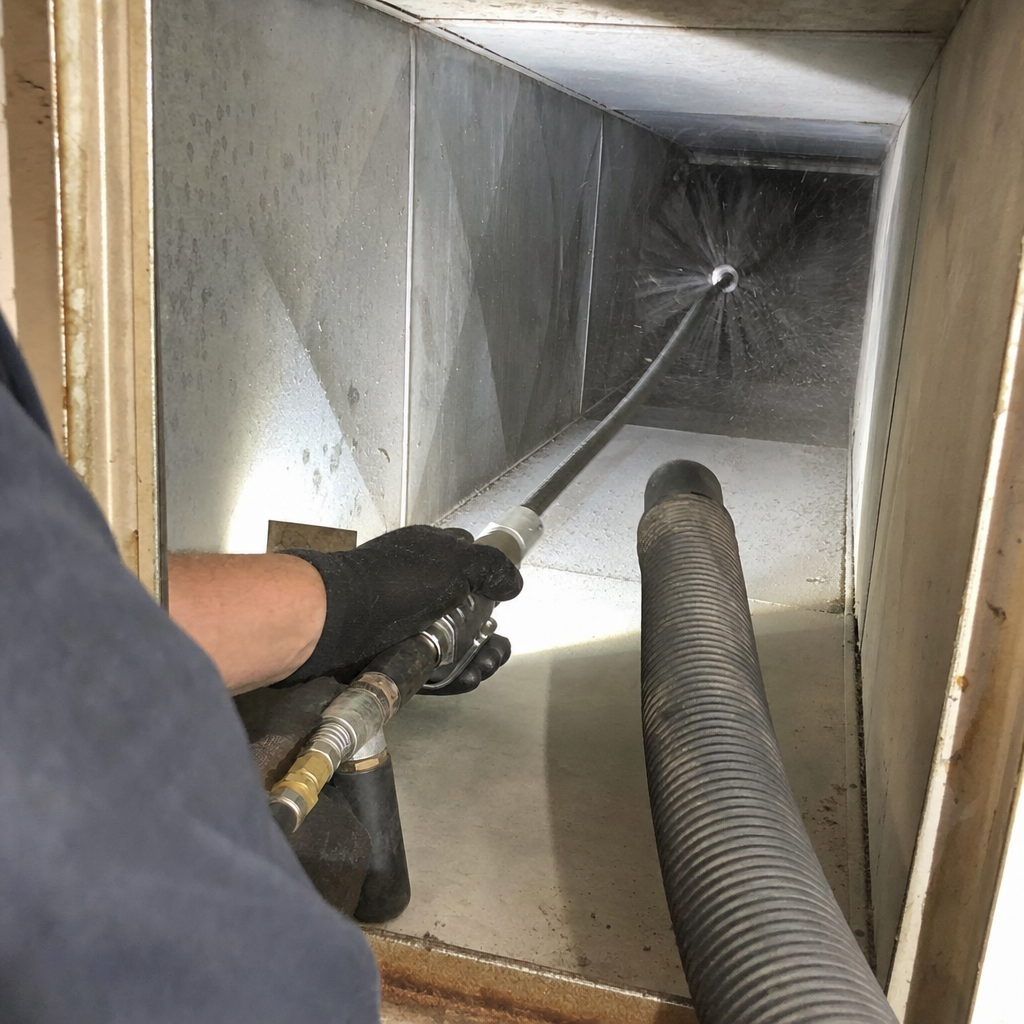
- “What specific equipment will you use, and can you describe how it works?” Legitimate contractors name brands and methods: Rotobrush or Nikro rotary brush systems, HEPA-filtered negative air machines, compressed air whips. Evasive answers (“professional-grade equipment”) or descriptions of simple shop vacuums indicate inadequate tooling.
- “How many access points will you create, and where?” A thorough cleaning requires strategic access — typically 8–12 openings in a standard Seattle home. The contractor should specify locations (main trunk line, return plenum, individual branch lines) without seeing the system. “We’ll figure that out when we get there” suggests they’re winging it.
- “Will you clean the entire system, including returns and supply lines, or only what’s visible?” Partial cleaning is worse than none — it disturbs debris without removing it, potentially worsening air quality. The answer must be comprehensive.
- “What’s your process for protecting floors, walls, and furnishings during work?” Professional contractors describe drop cloths, corner guards, and HEPA containment. The absence of a systematic approach predicts damage or mess.
- “Who will actually perform the work — employees, subcontractors, or owner-operators?” This reveals accountability structure. Subcontractor models common in large HVAC companies mean the person you spoke with may never see your home.
- “What’s your pricing structure, and what could change it after you arrive?” Fixed pricing based on system size (number of vents, square footage, furnace count) is standard. Open-ended estimates invite the upsell.
- “Can you provide local references from the past 30 days?” Recent, verifiable references in your area — Greenwood, Fremont, Beacon Hill — demonstrate consistent current operation, not accumulated old reviews.
- “What’s your protocol if you discover unexpected conditions — mold, asbestos, damaged ductwork?” The answer should involve stopping work, documenting with photos, and referring to appropriate specialists. Immediate pressure to authorize additional services on the spot is the bait-and-switch signature.
We’ve found that legitimate Seattle contractors welcome these questions — they’ve answered them before, they’re proud of their process, and they recognize an informed customer. Operators with something to hide become impatient, deflect, or offer to “just come take a look” without answering.
How to Read a Quote Structure
A legitimate quote is a scope of work document, not a price. Here’s what separates professional documentation from vague estimates designed to expand on arrival.
Elements of a Legitimate Quote
| Component | What to Look For | Red Flag |
|---|---|---|
| System description | Number of supply vents, return vents, furnaces, and main trunk lines | Generic “whole house” without specifics |
| Access plan | Specific locations where openings will be created and sealed | No mention of access methodology |
| Equipment specified | Brand names (Rotobrush, Nikro) or specific system types | “Commercial equipment” or “high-powered vacuum” |
| Protection measures | Floor covering, wall protection, furniture safeguarding | Absent entirely |
| Contingency protocol | Process for unexpected findings with cost thresholds | “We’ll assess on-site and advise” |
| Total price | Fixed number with payment terms | Range with wide spread ($150–$600) |
Seattle pricing for legitimate residential duct cleaning typically falls between $400–$800 for a complete system, with variables including home size, accessibility (crawl space vs. basement), and contamination level. Quotes below $300 for whole-system cleaning are structurally unprofitable at legitimate labor and equipment costs — the difference gets made up through upselling or corner-cutting.
Request the quote in writing, with the contractor’s Washington license number included. This creates accountability and demonstrates they operate transparently.
Why “Owner-Operated” Means More in Duct Cleaning
In many trades, the distinction between owner-operated and employee-staffed models is a matter of scale. In duct cleaning, it’s a matter of technique consistency that directly affects outcome quality.
Duct systems are not standardized. A 1920s Craftsman in Wallingford has galvanized steel ducts with decades of accumulated particulate, accessed through tight crawl spaces. A 1990s split-level in Shoreline has flex duct that requires different brush tension and vacuum calibration. A downtown Seattle high-rise unit has limited access and specific building protocols. The technician’s judgment — brush speed, vacuum strength, access point selection — determines whether debris is removed or merely redistributed.
In employee-staffed models, even well-intentioned companies face structural constraints: technician turnover, commission pressure, and the inevitable variation between workers. We’ve heard from Seattle property managers who’ve used the same company for years yet experienced dramatically different results depending on which technician was dispatched.
Owner-operated models, by contrast, centralize accountability. When Richard Anderson responds to an inquiry, performs the assessment, and operates the equipment, there’s no information loss between sales promise and execution. The reputation stake is personal, not corporate. For invisible, inside-the-walls work like duct cleaning, this accountability structure matters more than in visible trades where quality is immediately apparent.
This isn’t to suggest all employee-staffed operations are problematic — some excellent companies exist. But in a market with Seattle’s bait-and-switch prevalence, owner-operated structure is one verifiable indicator of accountability that reduces your risk.
Seattle-Specific Red Flags
Certain warning signs are particularly prevalent in the Seattle market. Watch for these specific patterns:
- The “mold specialist” pivot. Contractors who arrive, perform minimal work, then present alarming photos of “toxic mold” requiring immediate expensive treatment. True mold assessment requires laboratory analysis, not a flashlight and a worried expression. Seattle’s humidity does create genuine mold conditions, but legitimate identification follows protocol, not sales pressure.
- The wildfire smoke upsell. Post-2020, some operators exploit legitimate Seattle anxiety about smoke infiltration to sell unnecessary “sealing” or “sanitizing” services. While smoke damage is real, the solution is thorough source removal, not magical coatings.
- Inability to name Seattle neighborhoods or building types. Out-of-area call centers dispatching to Seattle without local knowledge. Ask about specific experience with your area — a legitimate local contractor knows the difference between Capitol Hill Victorians and Issaquah Ridge new construction.
- Pressure to decide immediately. “This price is only good if you book today” or “I have another crew in your area this afternoon.” Legitimate Seattle contractors have steady enough business not to require snap decisions.
- No physical business address. PO boxes or missing addresses suggest fly-by-night operations. Verify through the Washington Secretary of State business search.
- Payment demands before work completion. Standard practice is payment upon satisfactory completion, not upfront deposits for standard residential work.
Common Mistakes to Avoid
- Choosing by price alone. The lowest bid in Seattle’s duct cleaning market is almost always the bait-and-switch operator. The $99 special becomes $700+ on-site. Quality work at legitimate pricing protects you from this pattern.
- Assuming HVAC companies do quality duct cleaning. Many generalist HVAC contractors add duct cleaning as a low-margin upsell, performed by the least experienced technician with rental equipment. Specialist focus matters for technique and equipment quality.
- Not verifying credentials independently. Taking a contractor’s word for NADCA membership, licensing, or insurance without direct verification. The five minutes of checking saves hours of dispute resolution.
- Ignoring the access plan. Accepting vague descriptions of how technicians will reach your ductwork. In Seattle’s older homes with finished basements and limited crawl space access, this planning determines whether the job is possible without damage.
- Booking without recent local references. Reviews accumulated years ago may not reflect current ownership, staffing, or practices. Request references from jobs completed in your area within the past month.
- Neglecting post-cleaning verification. Not asking how you’ll know the work was effective. Legitimate contractors offer visual documentation (before/after photos through access points) or can explain measurable indicators of improved airflow and system performance.
- Failing to check for complementary service needs. In Seattle’s climate, dryer vent cleaning often accompanies duct cleaning due to lint accumulation from frequent indoor drying seasons. Bundling with a single specialist is efficient; discovering the need separately means paying separate trip charges.
When to Call a Professional
Schedule a professional duct cleaning assessment when you notice persistent dust accumulation shortly after cleaning, uneven heating or cooling across rooms, musty odors when the system runs, or visible debris in vent openings. After renovation work — particularly common in Seattle’s active remodeling market — duct cleaning removes construction particulate that bypasses standard filtration. Property managers should consider systematic cleaning between tenancies, as accumulated contaminants affect both tenant satisfaction and HVAC longevity.
Landmark Air Duct Cleaning Service Washington offers free estimates in Seattle — call (877) 335-1974 to discuss your specific system and receive a detailed scope of work before any commitment. Richard Anderson personally assesses each project and oversees the work from access planning through final verification.
Frequently Asked Questions
Complete residential duct cleaning in Seattle typically ranges from $400–$800 depending on home size, system complexity, and accessibility. Single-furnace homes in neighborhoods like Green Lake or Phinney Ridge with basement access tend toward the lower end; multi-level homes in Magnolia or Queen Anne with crawl space ductwork may run higher. Quotes significantly below this range should trigger credential verification — they’re rarely sustainable without upselling. Call (877) 335-1974 for a fixed quote based on your specific system — estimates are free.
Every 3–5 years for standard residential systems, with shorter intervals if you have pets, allergies, or recent renovation. Seattle’s high humidity and extended indoor seasons mean systems work harder and accumulate particulate faster than drier climates. Homes near major arterials like I-5 or Aurora Avenue may need more frequent attention due to traffic-related particulate infiltration.
Duct cleaning addresses the distribution network — supply and return lines, trunk lines, and registers. HVAC cleaning includes the furnace or air handler components: blower motor, evaporator coil, and heat exchanger. For complete system performance, both are necessary. HVAC Cleaning in Tacoma follows similar standards, though Seattle’s older housing stock often presents additional access challenges.
Surface cleaning of visible register covers is feasible for homeowners, but complete system cleaning requires professional equipment. Rotary brush systems like Rotobrush and high-powered HEPA vacuums like Nikro units reach deep into ductwork and maintain negative pressure to prevent debris redistribution. More critically, improper technique can damage flex duct, dislodge connections, or create access points that compromise system integrity. For the full scope of work, professional service is the practical choice.
The primary indicators are pricing structure and phone-screening behavior: quotes with wide ranges rather than fixed prices, reluctance to specify equipment or access methodology, pressure to book immediately, and inability to explain what could legitimately change the price after arrival. In Seattle specifically, the $99 entry point is the most common bait — no legitimate operator can cover labor, equipment, fuel, and disposal at this price point. Verify credentials independently and trust your screening process.
Yes, when the company is a legitimate specialist. Bundling eliminates separate trip charges and ensures consistent technique. In Seattle’s climate, where frequent rain extends indoor dryer use, lint accumulation accelerates — and clogged dryer vents present genuine fire risk. Dryer Vent Cleaning in Tacoma demonstrates the same specialist approach, though Seattle homeowners should verify local experience with their specific building type.
The Bottom Line
Hiring a duct cleaning contractor in Seattle rewards methodical verification. The three credentials — NADCA membership, active Washington license, and documented insurance — filter out most problematic operators before you spend time on phone calls. The eight screening questions reveal preparation and transparency. Quote structure analysis distinguishes legitimate scope-of-work documentation from vague estimates designed to expand. And understanding why owner-operated structure matters in this specific trade helps you value accountability over scale.
The Seattle market’s genuine air quality challenges — humidity, smoke season, aging housing stock — deserve serious attention from qualified specialists. The bait-and-switch operators exploit that legitimate concern. This guide gives you the tools to direct your business toward contractors who’ve built reputations through repeatable quality, not pressure tactics.
Ready to assess your system? Call Landmark Air Duct Cleaning Service Washington at (877) 335-1974 for a free, no-obligation estimate. Richard Anderson will evaluate your specific duct configuration, explain the access plan and equipment approach, and provide a fixed quote before any work begins. Landmark Air Duct Cleaning Service Washington home | Air Duct Cleaning in Tacoma
Written by Richard Anderson, Owner & Lead Technician at Landmark Air Duct Cleaning Service Washington, serving Seattle since 2015.