
Air Duct Sanitizing Service in Washington, WA: What It Actually Does and When It’s Worth Paying For
Professional air duct sanitizing in Washington typically runs $250–$450 for a standard residential system when performed as a standalone treatment, or $150–$280 as an add-on to full duct cleaning. At Landmark Air Duct Cleaning Service Washington, we apply EPA-registered sanitizers only after mechanical agitation and extraction — never before — and we do it with owner-led precision. Call (877) 335-1974 for a free estimate on your system.
The Sequence Problem Nobody Talks About
Here’s the tell that separates a legitimate sanitizing treatment from a revenue add-on: if a company offers to fog your ducts before they’ve been mechanically cleaned, you’re paying for a product that can’t do its job.
We’ve seen this in Capitol Hill rowhouses, Petworth basements, and Columbia Heights condos — a technician runs a fogger through dirty ducts, bills for “sanitizing,” and leaves behind a thin film of product sitting on top of dust, skin cells, and construction debris that’s been accumulating since the Reagan administration. The EPA-registered sanitizer never contacts the actual duct wall. It’s like spraying Lysol on a muddy floor and calling it disinfected.
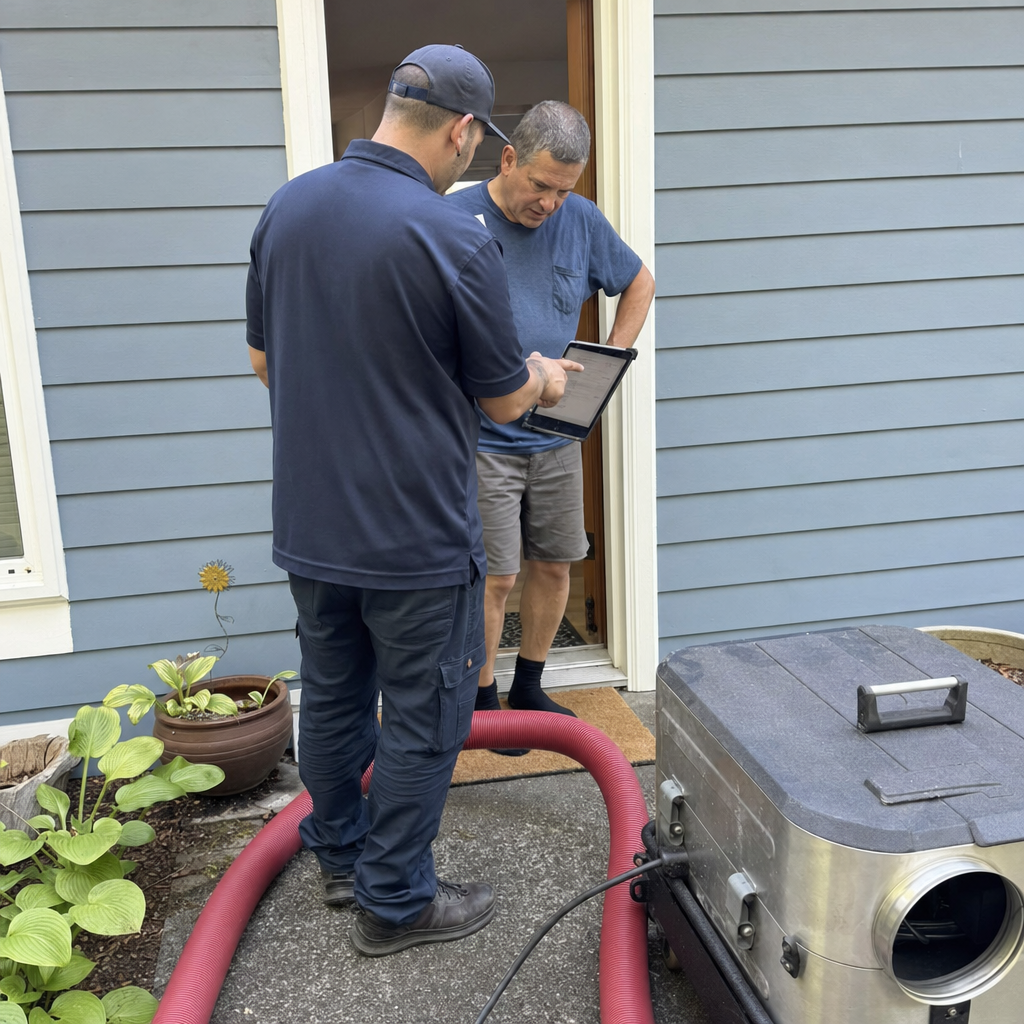
The correct sequence is non-negotiable: mechanical agitation and extraction first, then targeted application. In our work across Washington, we use Rotobrush and Nikro systems to physically dislodge debris from duct walls — the brushes make contact, the vacuum extracts at the point of disturbance, and only then do we assess whether sanitizing is warranted. Richard Anderson, our Owner and Lead Technician, makes that call on every job. He’s the same person who ran the cleaning equipment, so he’s seen what came out and knows what’s still there.
This matters particularly in Washington’s housing stock. The city’s pre-war buildings in neighborhoods like Georgetown and Dupont Circle often have galvanized ductwork with decades of layered accumulation. Newer construction in Navy Yard or NoMa frequently uses flex duct that’s more porous and harder to clean mechanically. The condition of the system after cleaning — not before — determines whether sanitizing adds value or just adds cost.
What “Sanitizing” Actually Means Versus What It’s Sold As
Most homeowners who search “air duct sanitizing service” are trying to solve one of three problems: persistent musty odors, recent water intrusion or flooding, or health symptoms they suspect tie back to the HVAC system. The right product, applied correctly, can address the first two. It’s not a medical intervention for the third, and anyone who frames it that way is overselling.
Here’s what distinguishes a legitimate treatment:
- EPA registration for HVAC use — not general surface disinfection, but specifically labeled for duct application
- Product matched to the biological concern — mold-adjacent biofilm requires different chemistry than bacterial odor sources
- Controlled application rate and dwell time — not a fog-and-run, but measured coverage that treats without oversaturating
- Post-application verification — visual inspection that product reached the target zones, not just the accessible registers
We work with products from Honeywell, Aprilaire, and Abatement Technologies — brands that manufacture for restoration contractors and commercial IAQ applications, not consumer retail. These carry EPA registration numbers you can verify, application protocols from the manufacturer, and safety data sheets that specify occupant re-entry times. Generic “deodorizing” foggers from hardware stores or unmarked bottles from a technician’s truck don’t meet that standard.
The question every homeowner should ask: “Is the product you’re using EPA-registered for this specific use case?” A yes means there’s documented efficacy and safety testing for duct application. A no means you’re paying for fragrance and hope.
Washington’s Climate and Where Sanitizing Actually Helps
Washington’s summer humidity — July averages near 70% relative humidity — creates conditions that mechanical cleaning alone sometimes can’t fully address. We’ve found this especially in crawl-space duct runs common in Capitol Hill and Mount Pleasant basements, where seasonal moisture drives condensation on duct exteriors that eventually migrates inward. The result isn’t always visible mold; more often it’s a thin biofilm that produces that characteristic musty startup smell when the AC kicks on in June.
In these cases, post-cleaning sanitizing has documented value. After Rotobrush agitation and Nikro extraction remove the bulk debris, an EPA-registered treatment can address the biological layer that mechanical methods don’t fully eliminate from porous duct seams or flex-duct crevices. We’ve tracked this specifically in homes near Rock Creek Park and the Anacostia corridor, where tree canopy and proximity to water amplify humidity effects.
Conversely, in dry winter conditions — January humidity often drops below 50% — we rarely recommend sanitizing unless there’s been a specific water event. The biological activity simply isn’t there to justify it. Richard’s made this call against revenue more than once; if the duct system is clean and dry, adding sanitizer is waste, not service.
| Service Component | Price Range |
|---|---|
| Air duct sanitizing (standalone, residential) | $250 – $450 |
| Sanitizing add-on to full duct cleaning | $150 – $280 |
| Post-water-intrusion treatment (includes inspection) | $350 – $550 |
| Commercial system sanitizing (per sq ft of served space) | $0.15 – $0.30 |
How We Apply It: Owner-Led, Not Crew-Dispatched
There’s a structural reason most duct cleaning companies can’t guarantee proper sanitizing: the person who cleans the ducts and the person who applies sanitizer are often different people, sometimes on different days, sometimes from different subcontractors. The fogging technician didn’t see what came out. The cleaning technician doesn’t know what product went where. Accountability fragments.
At Landmark, Richard Anderson runs every job himself or alongside his small crew. When sanitizing is warranted, he’s the one who cleaned the system, assessed what remained, selected the appropriate product concentration, and controls the application rate and coverage pattern. He’s also the one who verifies dwell time and clears the system for re-occupancy.
This matters for coverage consistency. Duct systems aren’t uniform cylinders — they have takeoffs, dampers, transitions, and flex sections that create turbulence zones where fogging alone deposits unevenly. Richard’s eleven years of duct-specific work means he knows where those zones are in Washington’s common building types: the sharp 90-degree turns in 1920s brick apartment conversions, the long straight runs in 1960s garden-style complexes, the cramped crawl-space distribution in Capitol Hill English basements. He adjusts application method accordingly — sometimes mist, sometimes targeted stream, sometimes repeated light passes rather than single heavy saturation.
Our Air Quality & Sanitizing work extends beyond ducts to whole-system treatment, but the principle holds: the same eyes that diagnosed the problem manage the solution.
When We Recommend Sanitizing, and When We Don’t
After eleven years and 732 customer reviews, we’ve developed a straightforward decision framework:
- Recommend: Visible mold or mildew in ductwork; persistent musty odor that survives thorough cleaning; documented water intrusion or flooding; immunocompromised occupants with physician-directed IAQ concerns; recent pest infestation in duct runs
- Don’t recommend: Routine maintenance cleaning with no biological indicators; systems with significant unresolved moisture source (fix the leak first); homeowner expectation of medical outcome; pressure to “just do it for peace of mind” without diagnostic basis
We turn down sanitizing work when the conditions don’t support it. That’s easier to do when the owner is on the job site making the call, not a commissioned technician working from a script. Richard’s view is straightforward: “If I can’t tell you exactly what I found and why it needed cleaning, I haven’t done my job.” The same applies to telling you why sanitizing isn’t necessary.
What to Expect During a Sanitizing Treatment
For Washington homeowners who proceed, here’s the actual sequence:
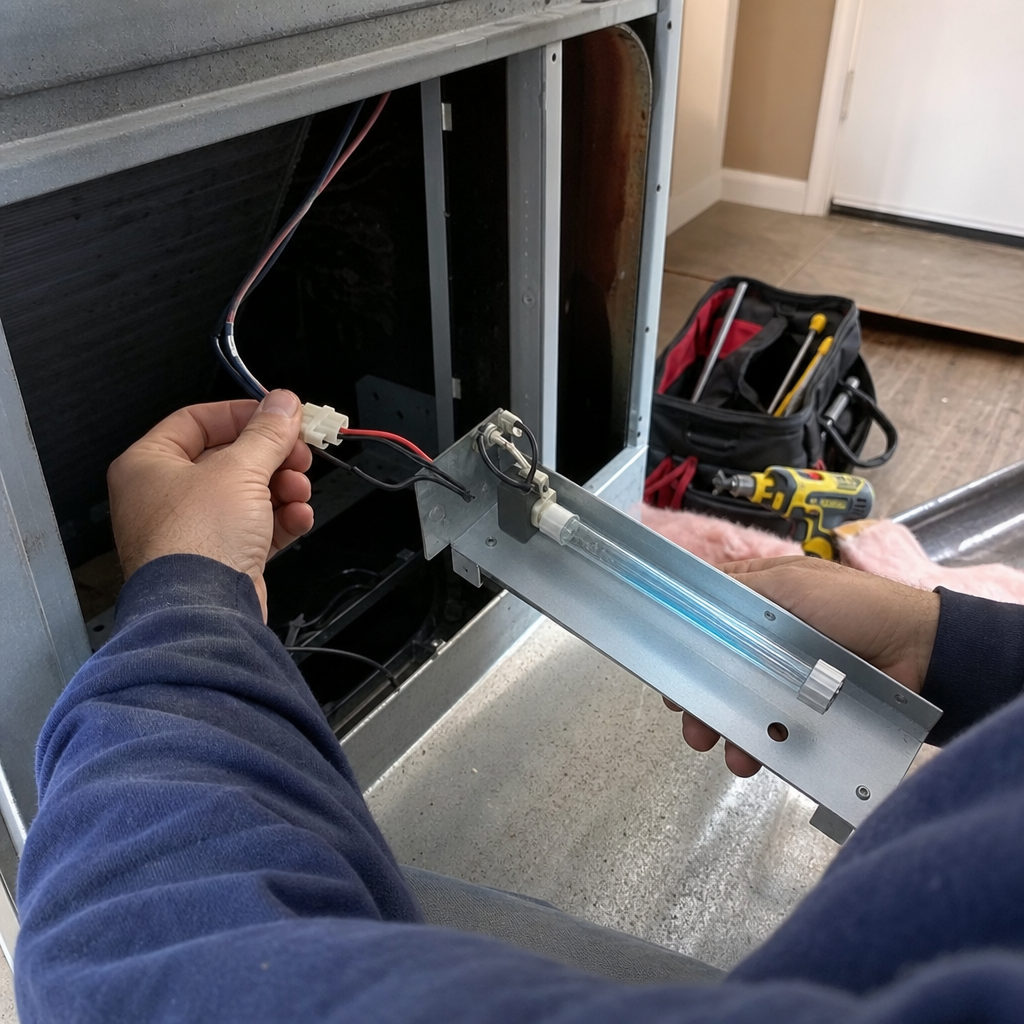
First, we verify the system has been mechanically cleaned within the same service cycle — either we performed it or we inspect another contractor’s work and may require re-cleaning if standards weren’t met. Second, we identify the specific biological concern through visual inspection and, when warranted, surface sampling. Third, we select the appropriate EPA-registered product — Honeywell and Aprilaire formulations for most residential applications, Abatement Technologies for commercial or restoration contexts — and calculate application rate based on duct volume and linear footage.
During application, we seal returns and pressurize the system to drive product through the full distribution network, not just accessible trunk lines. We time dwell period according to manufacturer specification — typically 10–20 minutes — then run the system to clear residual aerosol before occupant re-entry. Richard verifies coverage with borescope inspection of representative duct sections.
Total time for a residential sanitizing treatment, including pre-cleaning verification: 2.5–4 hours. We schedule these during business hours to allow proper ventilation and verification time.
FAQs
Professional air duct sanitizing in Washington, WA typically costs $250–$450 as a standalone service or $150–$280 when added to full duct cleaning, with post-water-intrusion treatments running $350–$550 due to additional inspection requirements. Commercial pricing runs $0.15–$0.30 per square foot of served space. Call (877) 335-1974 for an exact quote on your system — estimates are free.
Cleaning alone is less expensive upfront, but if your system has biological growth or persistent odor from Washington’s humid summers, cleaning without sanitizing often means paying twice when the problem returns. For homeowners concerned about Air Quality & Sanitizing Near Me in Washington, WA, we ensure the treatment matches your actual needs. We only recommend sanitizing when diagnostic evidence supports it — never as automatic upsell. Richard Anderson assesses each system personally before adding any treatment.
Technically yes, but effectively no — sanitizer applied over debris can’t contact the duct surface it’s meant to treat, wasting product and money. We refuse to perform standalone sanitizing on uncleaned systems; the sequence matters for both efficacy and your investment. If another company offers fogging without prior mechanical cleaning, that’s a red flag for upsell behavior.
Ask for the EPA registration number and verify it’s registered specifically for HVAC duct application, not general surface disinfection — this distinction separates legitimate IAQ products from generic deodorizers. At Landmark Air Duct Cleaning Service Washington, we use EPA-registered formulations from Honeywell, Aprilaire, and Abatement Technologies with documented safety data sheets and manufacturer protocols. We provide product documentation on request before any application begins.
Ready to Get Your Ducts Properly Assessed?
If you’re dealing with persistent odors, recent water damage, or just want an honest evaluation of whether your Washington home’s duct system needs more than cleaning, call (877) 335-1974 for a free estimate. Richard Anderson will inspect your system personally, explain exactly what he finds, and recommend sanitizing only if the evidence supports it. No fogging without cleaning first. No treatments without diagnosis. Just eleven years of specialist expertise applied to your specific home.
Written by Richard Anderson, Owner & Lead Technician at Landmark Air Duct Cleaning Service Washington, serving Washington, WA.