
Aprilaire Air Duct Cleaning in Seattle: A Homeowner’s Guide
Aprilaire whole-home humidifiers integrated with forced-air systems in Seattle homes require specialized duct cleaning protocols that account for sustained moisture introduction into the duct stream. Proper Aprilaire air duct cleaning runs $350–$850 in the Seattle market depending on home size, humidifier configuration, and whether mold remediation is needed downstream of the unit. If you’d rather not navigate the inspection and calibration steps yourself, call Landmark Air Duct Cleaning Service Washington home at (877) 335-1974 — we offer free estimates and same-week scheduling across the metro.
Here’s the uncomfortable truth we see in Seattle homes from Ballard to Beacon Hill: the Aprilaire humidifier you installed to keep your hardwood floors from cracking may be creating the exact interior duct conditions — sustained localized moisture — that accelerate mold colonization on duct liner surfaces downstream. After 11 years of cleaning ducts in this market, we’ve learned that homes with integrated Aprilaire systems present a fundamentally different contamination profile than standard dry systems. Skip the humidifier-specific inspection, and you’re not cleaning the problem — you’re potentially spreading it.
How Aprilaire Humidifiers Change Your Duct Contamination Profile
Most Seattle homeowners understand that our persistent marine layer and winter rains create exterior moisture challenges. Fewer recognize how an Aprilaire unit fundamentally alters the interior moisture map of their duct system.
We see two dominant Aprilaire configurations in Seattle homes, and each creates distinct contamination patterns:
- Bypass models (the 500 and 600 series most common in 1,500–2,500 sq ft Seattle homes) divert warm air across a water panel and reintroduce it via a bypass duct. This creates a concentrated moisture plume in the supply trunk immediately downstream, typically 8–14 feet of duct where humidity levels spike 15–25% above ambient system air. That sustained 55–70% relative humidity zone is where we find accelerated fiberglass liner degradation and the telltale dark spotting that precedes active mold growth.
- Fan-powered models (the 700 and 800 series, increasingly common in newer Northgate and Columbia City construction) push moisture actively rather than relying on pressure differential. The forced distribution creates a wider but shallower moisture footprint — more duct surface area affected, but typically less saturated per square foot. These systems often show uniform light dust adhesion rather than the localized heavy buildup bypass units produce.
The critical distinction for Seattle homeowners: our ambient winter humidity already runs 75–85% outside. When you layer active humidification on top of that during November through February, you’re not just adding moisture — you’re eliminating the dry-cycle recovery that ducts in Denver or Minneapolis rely on to self-regulate. We’ve pulled water panels from Magnolia homes that were essentially incubating Penicillium and Cladosporium colonies, then blowing spore-laden vapor directly into supply ducts every time the furnace cycled.
The Pre-Cleaning Inspection Every Aprilaire System Needs
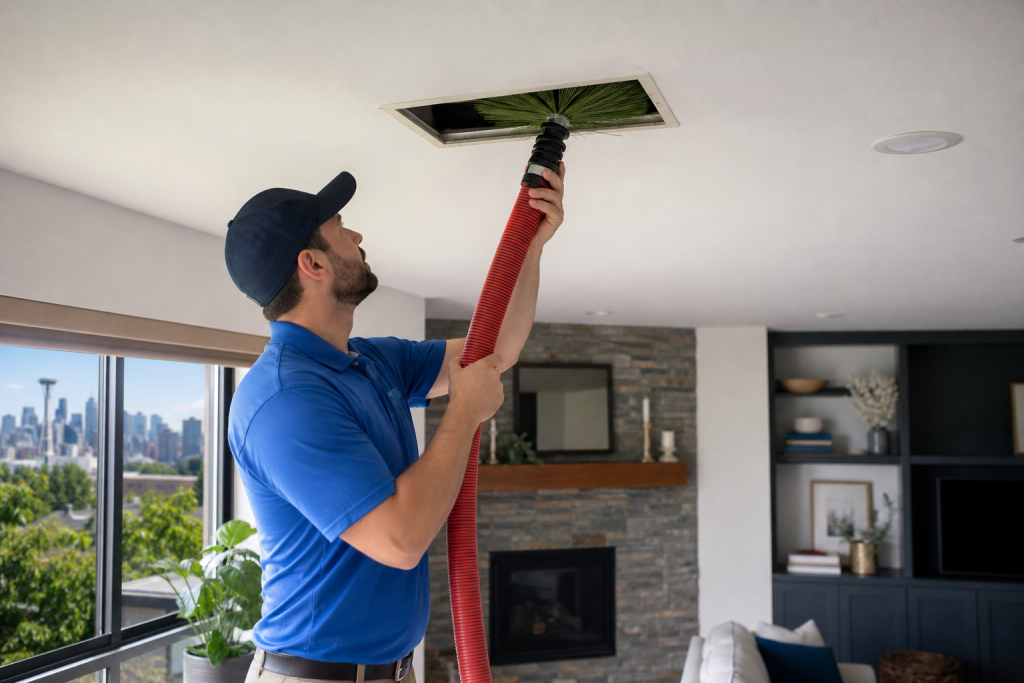
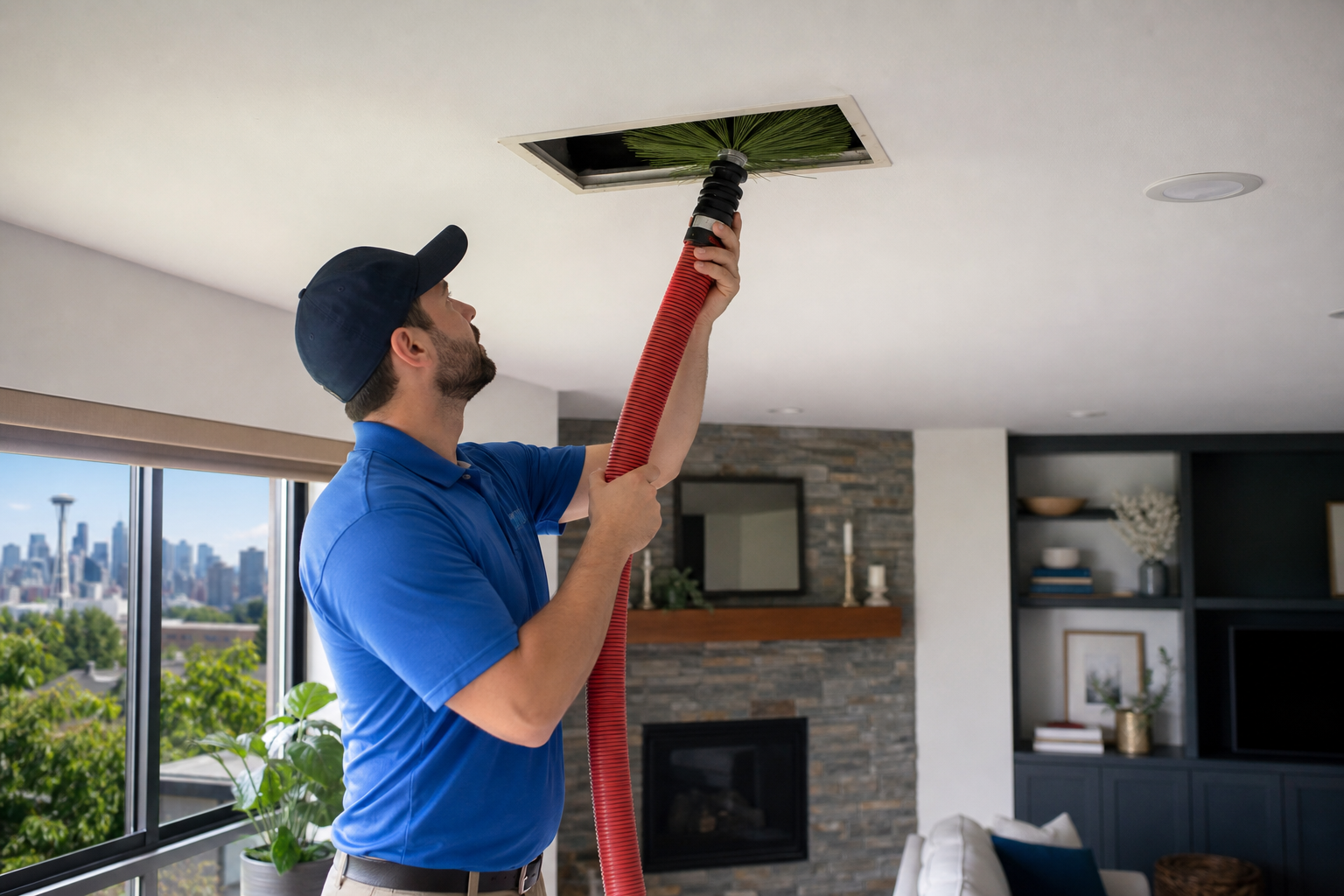
Before we run our Rotobrush system through any Seattle home with an Aprilaire, we perform a humidifier-specific inspection that generalist duct cleaners routinely skip. Here’s what that looks like, and why missing it can make contamination worse:
- Water panel condition and age. A panel past its recommended season — and we’ve found plenty in Ravenna basements that haven’t been changed in three years — becomes a biological reservoir. Distilled water recommendations are routinely ignored in Seattle, and our moderately hard municipal supply leaves mineral deposits that trap organic material.
- Drain line integrity. The Aprilaire drain must flow freely to the floor drain or pump. A partially clogged line creates back-saturation in the humidifier housing, which then wicks into adjacent ductwork through thermal bridging at the mounting flange. We use our Nikro inspection camera to verify drain function before any agitation cleaning begins.
- Duct liner assessment downstream. The 8–14 foot zone below a bypass unit needs direct visual inspection. If the liner shows delamination, dark staining, or a musty odor when probed, standard brushing will aerosolize spores rather than remove them. In these cases, we seal or replace the affected section before mechanical cleaning.
- Humidistat calibration verification. We check the control setting against actual duct humidity measurements. A miscalibrated humidistat set to 45% that’s actually delivering 60% is a hidden accelerator we need to flag for the homeowner.
Last month in a Wedgwood ranch, we encountered a textbook example: the homeowner had scheduled “standard duct cleaning” with a coupon service that never asked about the Aprilaire 600 mounted on the return plenum. Their Rotobrush agitation released a visible puff of dark particulate that the homeowner described as “like shaking out a wet beach towel.” We ended up treating that job as a contained remediation, not a routine cleaning. The previous service had made the air quality measurably worse for three days before the homeowner called us.
Seattle’s Seasonal Humidity Trap: When Running Aprilaire Backfires
Seattle’s climate creates a counterintuitive problem that Aprilaire owners in drier markets don’t face: there are months when humidification actively compounds moisture risk inside ducts.
Our marine west coast pattern means October through April brings not just rain but persistent high ambient humidity — often 80%+ for days at a stretch. During these periods, a home’s baseline interior humidity naturally sits in the 35–45% range without any mechanical assistance. Running an Aprilaire system set to 40% or higher during these months pushes duct humidity into the danger zone where condensation forms on cooler duct surfaces, particularly in unconditioned attic runs common in pre-1980s Seattle construction.
We see the seasonal pattern clearly in our call data:
- January–March: Highest rate of mold-positive duct inspections in Aprilaire-equipped homes, correlating with continuous winter humidification plus minimal natural ventilation
- May–September: Minimal humidifier use, but residual biological activity from winter moisture continues if not addressed — this is actually ideal cleaning season for these systems
- October–December transition: Sharp uptick in “musty smell when heat first turns on” calls, as dormant colonies reactivate with renewed moisture and warmth
The practical guidance we give Queen Anne and Capitol Hill homeowners: if your interior humidity without humidification already reads 40% on a basic hygrometer, your Aprilaire should be off or set to its minimum until outdoor conditions shift. The hardwood floors will survive brief dips to 30%; your duct liner won’t survive sustained 60%.
How to Brief Your Duct Cleaning Contractor on Aprilaire Configuration
Not every duct cleaning operation in Seattle understands humidifier-integrated systems. When you call for service, here’s what to communicate and what to expect from a technician who actually knows the equipment:
Tell them: Your Aprilaire model number (found on the unit faceplate), installation location (return plenum, supply plenum, or remote bypass), approximate age, and when the water panel was last changed. Mention any musty odors, visible moisture around the unit, or previous water leaks.
A qualified technician should then:
- Inspect the water panel and drain before touching ductwork
- Use containment or negative air isolation if downstream liner shows active biological growth
- Adjust cleaning agitation intensity based on whether you have flex duct, fiberboard, or metal trunk lines — Aprilaire moisture affects each differently
- Document pre- and post-cleaning humidity levels at the humidifier location
- Flag any duct liner degradation that requires repair or replacement rather than cleaning
We’ve developed specific protocols for Aprilaire-integrated systems over our 11 years of exclusive focus on indoor air quality. Our owner-led approach means Richard Anderson personally reviews the humidifier inspection before any mechanical cleaning begins — the kind of direct accountability that multi-trade HVAC companies with rotating crews structurally can’t replicate. We also carry Honeywell and Guardsman air quality products for homeowners whose Aprilaire systems need complementary filtration or sanitizing upgrades post-cleaning.
The Post-Cleaning Step Most Services Skip: Humidity Recalibration
Here’s the final piece that separates proper Aprilaire duct cleaning from a surface-level vacuum job: your humidistat needs recalibration after the system is cleaned.
A freshly cleaned duct network moves air differently. Removed buildup changes static pressure. Cleaned evaporator coils (if we performed HVAC cleaning as part of the service) alter temperature rise. These variables mean the humidistat setting that delivered 40% relative humidity before cleaning may now overshoot or undershoot by 10–15%.
We perform this recalibration as standard practice:
- Allow the cleaned system to run 24–48 hours to stabilize
- Measure actual delivered humidity at multiple supply registers using a calibrated psychrometer
- Adjust humidistat setting to achieve target without exceeding 45% at any register — our conservative ceiling for Seattle’s climate
- Document the new setting and seasonal adjustment recommendations for the homeowner
Skip this step, and you risk the exact recontamination cycle you’re trying to break: over-humidification in a now more efficient system, new moisture loading on clean duct surfaces, and mold recurrence within 18–24 months. We’ve returned to homes in Green Lake and Leschi where “annual duct cleaning” became a recurring expense because no one ever fixed the humidity control that caused the problem.
When to call a pro: If you can see moisture staining around your Aprilaire housing, smell mustiness when the blower cycles, or don’t know your water panel’s change date, you need inspection before any DIY filter swap. The $0 estimate call at (877) 335-1974 will tell you whether you’re looking at routine maintenance or something requiring contained remediation.
Related services in Seattle: Many Aprilaire-integrated homes benefit from our full-service approach — from Air Duct Cleaning in Tacoma and surrounding areas, to Dryer Vent Cleaning in Tacoma for comprehensive fire safety, and HVAC Cleaning in Tacoma when the full air handler needs attention alongside ductwork.
What happens when you call
- 1
A real person answersNo phone trees — you reach a local pro.
- 2
You get an upfront price rangeHonest numbers before anyone is dispatched.
- 3
A background-checked tech heads outLicensed & insured, dispatched right away.
- 4
You approve before work beginsNothing starts until you say go.
The Bottom Line
Aprilaire humidifiers solve real problems in Seattle’s dry-heating-season homes, but their integration with forced-air ductwork creates a moisture management responsibility that standard duct cleaning protocols don’t address. The key takeaways: know your model and its moisture distribution pattern; never skip the water panel and drain inspection; respect our climate’s natural humidity and adjust your humidistat seasonally; demand post-cleaning recalibration; and choose a specialist who understands the equipment, not a generalist with a vacuum hose.
If you’re in Seattle and want your Aprilaire-integrated system inspected, cleaned, and properly calibrated by a technician who’ll answer to the owner on every job, Landmark Air Duct Cleaning Service Washington offers free estimates with same-week availability. Call (877) 335-1974 or request a callback through our site.
Frequently Asked Questions
Standard duct cleaning for an Aprilaire-integrated system in Seattle runs $350–$650 for homes under 3,000 square feet, with mold remediation downstream of the unit adding $200–$400 if needed. The inspection, contained cleaning when indicated, and post-service humidistat calibration are all included in our flat-rate pricing. Call (877) 335-1974 for an exact quote — estimates are free.
We don’t recommend it. The water panel and drain inspection requires accessing the humidifier housing and duct interior, and improper agitation of biologically active liner material can aerosolize mold spores throughout your home. For Seattle homeowners, the health risk and equipment knowledge required make this a specialist job. If you suspect contamination, call for a professional assessment before attempting any DIY approach.
In Seattle’s climate, we recommend inspection every two years and full cleaning every three to five years for Aprilaire-equipped homes — more frequently if you run humidification continuously through winter, have pets, or notice musty odors. The water panel itself should be replaced annually at minimum, with monthly visual checks during heavy use periods. Regular maintenance prevents the accelerated contamination these systems can create.
Intermittent mustiness tied to blower operation strongly suggests biological activity in your ductwork, often concentrated downstream of an Aprilaire unit where moisture accumulates. The smell intensifies when airflow disturbs spore colonies. In Seattle’s humidity, this pattern warrants immediate inspection of the humidifier water panel, drain function, and downstream duct liner condition. Don’t mask it with air fresheners — the underlying moisture problem will worsen and spread. Call (877) 335-1974 to schedule a diagnostic inspection.
Written by Richard Anderson, Owner & Lead Technician at Landmark Air Duct Cleaning Service Washington, serving Seattle since 2015.
Need Air Duct Cleaning Help?
Call Landmark Air Duct Cleaning Service Washington — licensed & insured, here with fast after-hours help in Washington.
(877) 335-1974