
Last updated July 11, 2026
The Complete Guide to Air Duct Cleaning in Seattle
Seattle’s average relative humidity sits above 70% for six months of the year — a figure that changes everything about how biofilm and mold colonize duct liners in ways that Phoenix or Denver guides never address. In 11 years of inspecting Puget Sound duct systems, we’ve found that Seattle homeowners face a distinct contamination profile: moisture-driven mold growth on flex duct interiors, cedar dust embedded in pre-1980s ductwork from original construction, and wildfire ash from Eastern Washington events that migrates through even sealed systems. This guide draws on over 732 completed jobs across Seattle neighborhoods to explain what’s actually inside your ducts, how our marine climate shapes it, and what legitimate cleaning looks like in a market flooded with generalist HVAC upsells.
Quick Answer
Professional air duct cleaning in Seattle typically costs $400–$900 for a standard single-family home and should include full system inspection, negative-air extraction, and brush agitation of all supply and return lines. Because Seattle’s persistent humidity creates unique mold and biofilm conditions, the method matters — flex duct systems common in 1940s–1970s Seattle homes require different equipment and technique than rigid sheet metal. A legitimate specialist provides pre- and post-cleaning documentation, uses professional-grade systems like Rotobrush or Nikro units, and inspects before quoting rather than offering flat-rate phone pricing.
Table of Contents
- How Seattle’s Marine Climate Changes What’s in Your Ducts
- The Specific Contaminants Found in Seattle Homes
- Why Seattle’s Housing Stock Age Matters for Duct Cleaning
- Cleaning Methods: What the Equipment Actually Does
- NADCA-Standard Cleaning vs. the Generalist HVAC Upsell
- How to Read a Post-Cleaning Report
- What Air Duct Cleaning Costs in Seattle
- A Realistic Maintenance Schedule for Seattle Homes
How Seattle’s Marine Climate Changes What’s in Your Ducts
Most national duct cleaning guides treat humidity as a minor variable. In Seattle, it’s the dominant force.
Our marine west coast climate delivers two critical conditions that reshape duct contamination: sustained high relative humidity from October through April, and relatively narrow temperature swings that keep attic and crawl space ductwork in the mold growth “sweet zone” of 60–80°F for much of the year. In drier climates, dust remains inert particulate matter. In Seattle’s humidity, that same dust layer becomes a substrate for microbial growth — particularly on the porous interior surfaces of flex duct, which makes up an estimated 60–70% of residential ductwork in Seattle’s 1940s–1970s housing stock.
We’ve inspected ducts in Ballard bungalows and Capitol Hill Craftsman homes where the interior flex duct liner had developed a uniform biofilm coating — not dramatic black mold, but a pervasive gray-green layer that standard vacuuming won’t dislodge. The homeowner typically reports “musty smell when the heat first comes on” or “my allergies spike in fall.” The cause isn’t a single contamination event; it’s years of humidity-driven colonization that generic cleaning protocols miss.
Key differences in Seattle’s climate impact:
- Condensation cycles: Daily temperature swings in unconditioned attics create condensation on duct exteriors, which can migrate to interiors through seams and degrade insulation
- Reduced drying: Spills, roof leaks, or crawl space moisture events dry slowly; we’ve found active mold in Magnolia crawl space ducts three years after a minor flooding event
- Seasonal pressure differentials: Fall and spring temperature inversions can reverse normal stack effect, pulling attic air and contaminants into living spaces through duct leaks
This climate reality means Seattle duct cleaning requires equipment selection and technique calibrated for moisture-affected systems — not the same protocol used in arid climates.
The Specific Contaminants Found in Seattle Homes
National guides list “dust, pollen, pet dander” as generic duct contaminants. Seattle’s profile is more specific and more locally determined.
Cedar and Fir Construction Dust
Seattle’s housing boom periods — the 1940s war worker housing, the 1950s–60s suburban expansion, the 1970s condo conversions — used abundant Pacific Northwest softwoods. Original construction dust from cedar and fir framing, particularly in homes that have never had ducts cleaned, forms a distinctive fibrous mat inside ductwork. In Queen Anne and Wallingford homes built in the 1920s–1940s, we’ve extracted material that tests positive for cedar pollen and wood fiber decades after construction. This material is more abrasive than typical household dust and can accelerate blower motor wear if circulated continuously.
Wildfire Ash from Eastern Washington Events
The 2015, 2017, 2020, and 2022 wildfire seasons sent measurable particulate matter into Western Washington. Seattle’s PM2.5 levels spiked to hazardous ranges. What national guides don’t explain: even homes with windows closed during smoke events often show ash accumulation in ducts, because HVAC systems draw outside air for combustion and ventilation. We’ve found gray ash layers in return ducts of Ravenna and Wedgwood homes two years after major smoke events, particularly in systems with standard 1-inch pleated filters that don’t capture fine particulate.
Moisture-Driven Mold and Biofilm
The most significant Seattle-specific contaminant. Our climate supports:
- Cladosporium and Penicillium species on flex duct interiors — the “musty” smell source
- Biofilm communities on sheet metal at flex-metal junctions, where condensation collects
- Dust mite allergen accumulation in humidified systems, particularly in homes with whole-house humidifiers set above 45% in winter
In 11 years, we’ve never found the toxic black mold (Stachybotrys) that scare-marketing emphasizes. We have found extensive, symptom-causing microbial growth that responds to proper cleaning and source control.
Urban Particulate from I-5 and Industrial Corridors
Homes in Georgetown, South Park, and near major arterials show elevated diesel particulate and brake dust in return ducts — a function of Seattle’s topography trapping pollutants in low-lying areas.
Why Seattle’s Housing Stock Age Matters for Duct Cleaning
Seattle’s housing age distribution is not representative of national averages, and this directly impacts duct cleaning approach.
Approximately 55% of Seattle’s housing stock was built between 1940 and 1979, according to Census data. This concentration matters because:
- Duct materials differ by era. 1940s–1950s homes often have uninsulated galvanized sheet metal with asbestos-containing duct wrap (friable, requiring special handling). 1960s–1970s homes frequently used early flex duct with inferior vapor barriers that have degraded. 1980s+ construction more commonly uses modern flex duct or insulated sheet metal.
- Configuration surprises are common. In pre-1950s Seattle homes with later-added forced air, we’ve found ducts routed through abandoned chimney flues, under original post-and-pier foundations with no access, or connected to no-longer-functional gravity furnace vestibules. Cleaning without inspection risks damage or incomplete service.
- Seismic retrofit impacts. Post-Nisqually earthquake retrofitting in many Seattle homes included crawl space work that crushed, disconnected, or kinked duct runs. We regularly find 30–50% airflow restriction in retrofitted crawl spaces that the homeowner assumed was “just how the system is.”
Before any cleaning begins, a legitimate specialist inspects. In our practice, Richard Anderson personally evaluates duct configuration, material condition, and access points before equipment selection. We’ve declined jobs where asbestos wrap was present without abatement, where duct collapse made cleaning pointless without repair, or where the system was so poorly designed that cleaning would be cosmetic only.
Neighborhood-specific patterns we’ve observed:
- Madrona, Leschi, Mount Baker: 1900s–1920s homes with later furnace additions; complex duct routing, often significant leakage
- West Seattle, White Center: 1940s–1950s tract housing with original galvanized metal and degraded insulation
- Northgate, Lake City: 1960s–1970s split-levels with flex duct in attics; vapor barrier failure common
- Ballard, Fremont: Mixed-age stock with frequent remodels; ductwork from multiple eras spliced together
Cleaning Methods: What the Equipment Actually Does
Duct cleaning equipment varies enormously in capability. Seattle’s contamination profile — sticky biofilms, embedded construction dust, fine wildfire ash — demands specific approaches.
Negative Air Extraction (The Foundation)
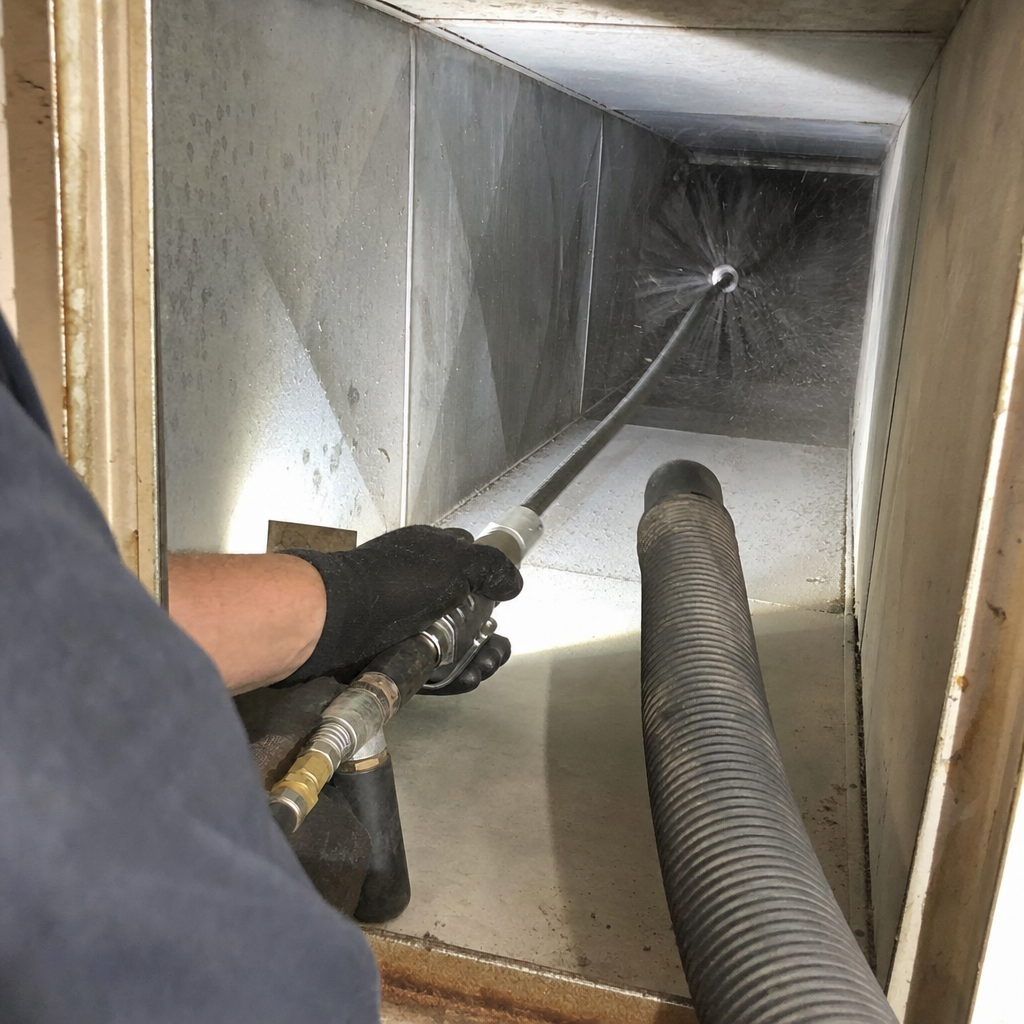
Professional cleaning connects a high-powered vacuum (typically 5,000+ CFM) to the duct system, creating negative pressure that prevents contaminant release into living spaces during agitation. This is non-negotiable for any legitimate service. Portable HEPA vacuums or shop vacs adapted for duct work do not achieve sufficient airflow.
Mechanical Agitation: Brush vs. Air Whip
The critical choice for Seattle systems:
- Rotating brush systems (like our Rotobrush units): Physical contact with duct interior dislodges adhered biofilm and embedded construction dust. Essential for flex duct, where air whip turbulence is partially absorbed by the flexible walls. Brushes sized to duct diameter prevent damage.
- Air whip / skipper ball systems: Compressed air-driven tools that bounce through rigid sheet metal. Effective for loose debris in metal duct, less effective for adhered contamination. Can damage degraded flex duct if misapplied.
We use both, selecting based on inspection findings. In a typical Seattle home with mixed duct materials, we’ll brush agitate flex runs and air-whip accessible metal trunk lines.
Compressed Air and Contact Vacuuming
Register boots, plenums, and coil surfaces require direct contact cleaning. Our Nikro equipment includes contact vacuuming tools with HEPA filtration for these components. This is where generalist services often shortcut — the visible registers get wiped, the hidden plenum does not.
Sanitizing Application (When Appropriate)
Not every job needs chemical sanitizing. We apply EPA-registered sanitizers only where inspection confirms active microbial growth, using products compatible with duct materials and occupied spaces. This is a diagnostic decision, not a standard upsell.
NADCA-Standard Cleaning vs. the Generalist HVAC Upsell
The National Air Duct Cleaners Association (NADCA) publishes standards for complete cleaning: all supply and return ducts, registers, grilles, diffusers, heat exchangers, cooling coils, drain pans, fan motor and housing, and the air handling unit. In Seattle’s market, the gap between this standard and what generalist HVAC companies deliver as a duct cleaning “add-on” is substantial.
We’ve been called to re-clean after generalist services that:
- Cleaned only the first 6 feet of accessible duct from each register, leaving 80%+ of the system untouched
- Used consumer-grade shop vacuums without negative air containment, releasing captured debris into living spaces
- Never accessed or inspected the air handling unit, where blower wheel and coil contamination directly impacts airflow and efficiency
- Provided no documentation — no before/after photos, no airflow measurements, no written scope of work
The generalist model makes economic sense for them: duct cleaning is a low-margin add-on to HVAC service calls, performed by technicians whose training and equipment focus on refrigerant and electrical work. The specialist model — our model at Landmark Air Duct Cleaning Service Washington home — inverts this. Richard Anderson’s 11 years of exclusive focus means equipment selection, technique, and quality verification are designed for duct systems specifically, not adapted from unrelated trade practices.
Key verification questions for any Seattle homeowner:
- Will you inspect the full system before quoting? (Phone flat-rate pricing without inspection is a red flag)
- What equipment brands and models will you use? (Vague answers suggest rental or consumer-grade tools)
- What does your scope of work include beyond the ducts themselves? (NADCA standard includes the full air handling system)
- What documentation will I receive? (Photos, airflow data, written report)
- Who performs the work — employees, subcontractors, or the owner? (Accountability varies enormously)
Our answers: yes, always; Rotobrush and Nikro professional-grade systems; full system per NADCA guidance; complete photo documentation and written report; Richard Anderson, Owner and Lead Technician, personally on every job.
How to Read a Post-Cleaning Report
Documentation separates legitimate specialists from operators who hope you won’t ask. A proper post-cleaning report should include:
| Report Element | What It Tells You | Red Flag If Missing |
|---|---|---|
| Before/after photography | Visual verification of contamination removal at representative access points | No photos, or only register surface “before/after” without duct interior documentation |
| System airflow measurement (CFM) | Quantified improvement in delivered air volume; validates that restrictions were removed | No airflow data, or “feels stronger” subjective assessment only |
| Contamination type documentation | What was found — dust loading, mold/biofilm, construction debris, moisture evidence | Generic “cleaned ducts” description without specificity |
| Scope completion checklist | Which components were accessed and cleaned: trunk lines, branch ducts, registers, boots, plenum, coil, blower, drain pan | Vague “whole system” claim without itemized verification |
| Recommended follow-up actions | Repairs, sealing, filter upgrades, humidity control, or maintenance interval based on findings | No recommendations, or immediate pressure to schedule additional services |
In our Seattle practice, we provide digital reports with timestamped photos, airflow measurements at key registers, and specific findings. If wildfire ash was present, we note it. If flex duct degradation suggests replacement need within 2–3 years, we document that rather than selling immediate replacement. This transparency is how we’ve maintained a 4.9-star average across 732 reviews — owner-led accountability means no incentive to obscure or oversell.
What Air Duct Cleaning Costs in Seattle
Seattle’s market runs higher than national averages due to labor costs, access challenges in older housing stock, and the additional time moisture-affected systems require. Based on our 11-year pricing history and current market observation:
| Service Scope | Typical Seattle Price Range | Factors Affecting Cost |
|---|---|---|
| Standard residential duct cleaning (single system, 1,500–2,500 sq ft) | $400–$700 | Number of registers, duct material accessibility, contamination severity |
| Larger home or multi-zone system (2,500–4,000 sq ft) | $600–$900 | Additional trunk lines, zone dampers, multiple air handlers |
| Condo or townhome (shared walls, limited access) | $350–$550 | Access constraints, HOA coordination, parking/logistics |
| HVAC cleaning (coil, blower, drain pan) | $200–$400 additional | Coil accessibility (A-coil vs. slab), blower removal requirements |
| Dryer vent cleaning (as add-on or standalone) | $125–$250 | Run length, roof termination vs. wall, blockage severity |
| Duct repair and sealing (per project) | $300–$1,500+ | Extent of leakage, access difficulty, materials needed |
Be cautious of Seattle-area pricing below $300 for whole-system cleaning — this typically indicates incomplete scope, equipment that doesn’t achieve negative air containment, or bait-and-switch tactics where the quoted price covers minimal work. We provide firm, inspection-based quotes with no hidden charges.
For property managers and multi-unit buildings in Seattle, we offer scoped proposals with per-unit pricing — call (877) 335-1974 for a custom estimate.
A Realistic Maintenance Schedule for Seattle Homes
Seattle’s climate and housing stock suggest more frequent attention than generic “every 3–5 years” guidance.
Our recommendation based on 11 years of observation:
| Home Profile | Recommended Interval | Additional Considerations |
|---|---|---|
| Standard Seattle home, no pets, no sensitivities | Every 4–5 years | Inspect visually at 3-year mark if humidity control is marginal |
| Homes with pets (shedding breeds) | Every 2–3 years | Pet dander accumulates faster; check filter condition quarterly |
| Allergy or asthma sufferers in household | Every 2–3 years, with IAQ assessment | Consider Aprilaire or Honeywell whole-house filtration upgrades between cleanings |
| Post-wildfire smoke event years | Assessment within 6 months of major event | Even with windows closed, fine particulate enters through ventilation |
| Pre-1970s homes with original ductwork | Inspection every 2 years, clean as needed | Degraded materials and leakage accelerate contamination; duct sealing often needed |
| Recent remodeling (demolition phase) | Post-construction cleaning + 2-year follow-up | Construction dust bypasses protection; fine particulate embeds in duct porous surfaces |
Between professional cleanings, Seattle homeowners should:
- Maintain humidity at 30–50% year-round — dehumidify in shoulder seasons, don’t over-humidify in winter
- Use MERV 11–13 pleated filters, changed every 2–3 months (monthly during wildfire smoke events)
- Visually inspect accessible registers seasonally for dust buildup, mold spotting, or moisture staining
- Schedule annual HVAC maintenance that includes blower and coil inspection — this is separate from duct cleaning but reveals upstream contamination sources
Common Mistakes to Avoid
- Choosing by price alone. The lowest Seattle duct cleaning bids typically exclude the air handling unit, use inadequate vacuum power, or send commission-driven technicians who find “urgent” problems that don’t exist. Our 732 reviews at 4.9 stars reflect transparent, inspection-based pricing.
- Ignoring flex duct condition. Seattle’s humidity degrades flex duct vapor barriers over 15–20 years. Cleaning degraded flex duct without assessing replacement need wastes money if the duct will be replaced within two years. We inspect for this before quoting.
- Expecting duct cleaning to fix HVAC problems it’s not designed to address. Duct cleaning improves air quality and removes airflow restrictions from contamination. It does not repair refrigerant leaks, replace failing compressors, or correct fundamentally undersized duct design. We diagnose and refer appropriately.
- Scheduling without verifying who’s performing the work. Many Seattle-area “duct cleaning” results on search engines are lead-generation services that sell to rotating subcontractors. Richard Anderson’s owner-led model means the same person who answers your questions performs the work.
- Neglecting dryer vent cleaning. In Seattle’s humidity, lint accumulation in dryer vents degrades more slowly than in dry climates — but fire risk remains. We recommend concurrent dryer vent service, particularly in homes with roof-terminated vents or runs over 15 feet.
- Over-humidifying in winter. Whole-house humidifiers set above 45% RH create ideal conditions for duct mold growth. We’ve cleaned systems where the humidifier was the primary contamination source. Monitor with a calibrated hygrometer.
When to Call a Professional
Call for inspection if you notice persistent musty odors when HVAC operates, visible mold on registers or in duct openings, dust accumulation returning rapidly after cleaning, uneven heating or cooling that suggests blockage, or recent wildfire smoke exposure with ongoing respiratory symptoms. For property managers, we recommend pre-tenancy inspection of duct systems in Seattle’s older rental stock — degraded ducts are a hidden liability that routine HVAC service won’t reveal.
Landmark Air Duct Cleaning Service Washington offers free estimates in Seattle — call (877) 335-1974. Richard Anderson personally inspects, quotes, and performs the work, with documentation that verifies complete service. We also serve Tacoma with dedicated Air Duct Cleaning in Tacoma, Dryer Vent Cleaning in Tacoma, and HVAC Cleaning in Tacoma services.
Frequently Asked Questions
Standard residential duct cleaning in Seattle typically ranges from $400 to $700 for a single system in a 1,500–2,500 square foot home, with larger homes or multi-zone systems running $600–$900. Condos and townhomes with access constraints usually fall between $350–$550. Final pricing depends on duct configuration, contamination severity, and whether HVAC component cleaning is included — call (877) 335-1974 for a free, inspection-based estimate with no hidden charges.
Most Seattle homes benefit from professional duct cleaning every 4–5 years, but our marine climate shortens this interval for specific situations: homes with pets or allergy sufferers (every 2–3 years), properties affected by wildfire smoke events (assessment within 6 months), and pre-1970s homes with original ductwork (inspection every 2 years). The persistent humidity that makes Seattle comfortable also supports biofilm growth that dry-climate guidance doesn’t address.
Professional duct cleaning with proper mechanical agitation removes mold and biofilm from accessible duct interiors, but it does not address the moisture source that allowed growth. In Seattle’s climate, we frequently find that duct mold indicates upstream humidity control problems — inadequate ventilation, over-humidification, or building envelope leaks. We document active growth, clean affected areas, and specify moisture source remediation to prevent recurrence. Extensive mold in porous flex duct may require section replacement rather than cleaning alone.
Specialists like Landmark focus exclusively on duct systems and indoor air quality, with equipment and technique optimized for this single trade. Generalist HVAC companies typically perform duct cleaning as a low-margin add-on, often using adapted equipment and technicians whose primary training is in refrigerant and electrical work. The NADCA-standard scope — full duct system plus air handling unit — is more consistently delivered by dedicated specialists who’ve invested in proper negative-air systems and rotary brush equipment.
Moderate improvements are realistic — typically 5–15% HVAC efficiency recovery when duct cleaning removes significant airflow restriction from contamination. The greater benefit in Seattle’s climate is equipment longevity: reduced blower motor strain and coil efficiency preservation. We measure airflow before and after cleaning to document actual improvement. Duct cleaning does not, however, compensate for fundamentally undersized equipment, poor insulation, or envelope leakage that drives Seattle’s higher heating loads.
Verify four specifics: they inspect before quoting (not flat-rate phone pricing), they name their equipment brands (professional-grade systems like Rotobrush or Nikro, not shop vac adaptations), they itemize scope in writing including the air handling unit, and they provide post-cleaning documentation with photos and measurements. Owner accountability matters — ask who performs the work. At Landmark, Richard Anderson is Owner and Lead Technician on every job, a structure that multi-trade operations typically cannot match.
The Bottom Line
Seattle’s marine climate, distinctive housing stock, and specific contamination profile — moisture-driven biofilm, embedded cedar construction dust, and periodic wildfire ash — make generic duct cleaning guidance inadequate. Effective service requires inspection-based scoping, equipment selection matched to flex duct or rigid metal systems, and documentation that verifies complete work. The lowest bid rarely delivers this; the specialist with 11 years of single-trade focus, owner-led accountability, and 732 verified reviews reflecting consistent execution does. From cleaning to sealing to sanitizing, the full-service arc protects both air quality and HVAC system integrity in conditions that Seattle’s humidity makes uniquely demanding.
Written by Richard Anderson, Owner & Lead Technician at Landmark Air Duct Cleaning Service Washington, serving Seattle since 2015.