
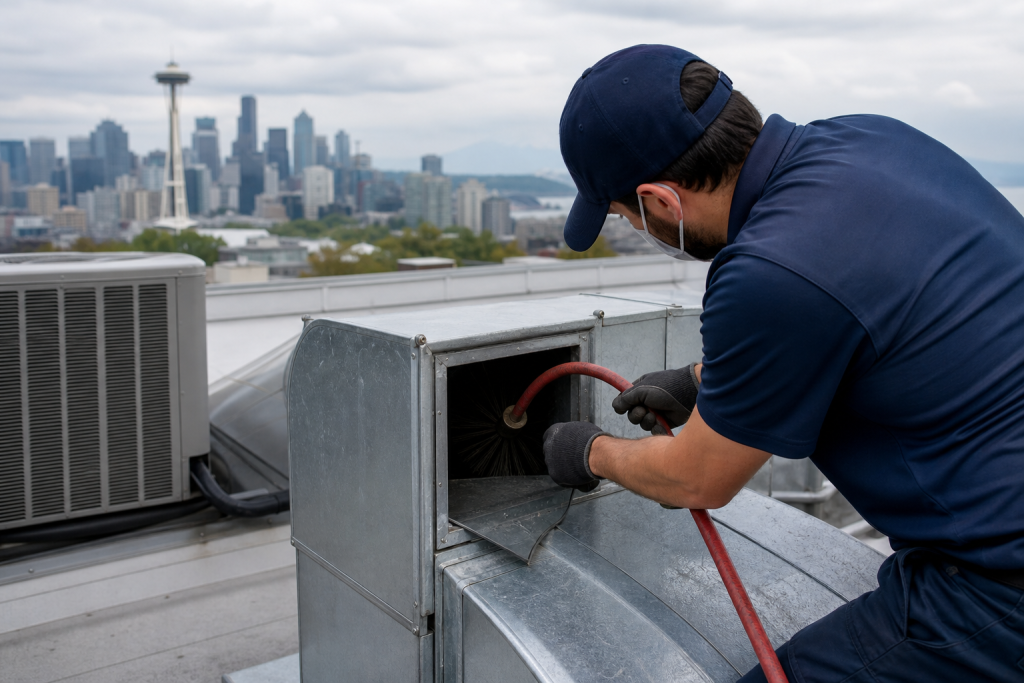
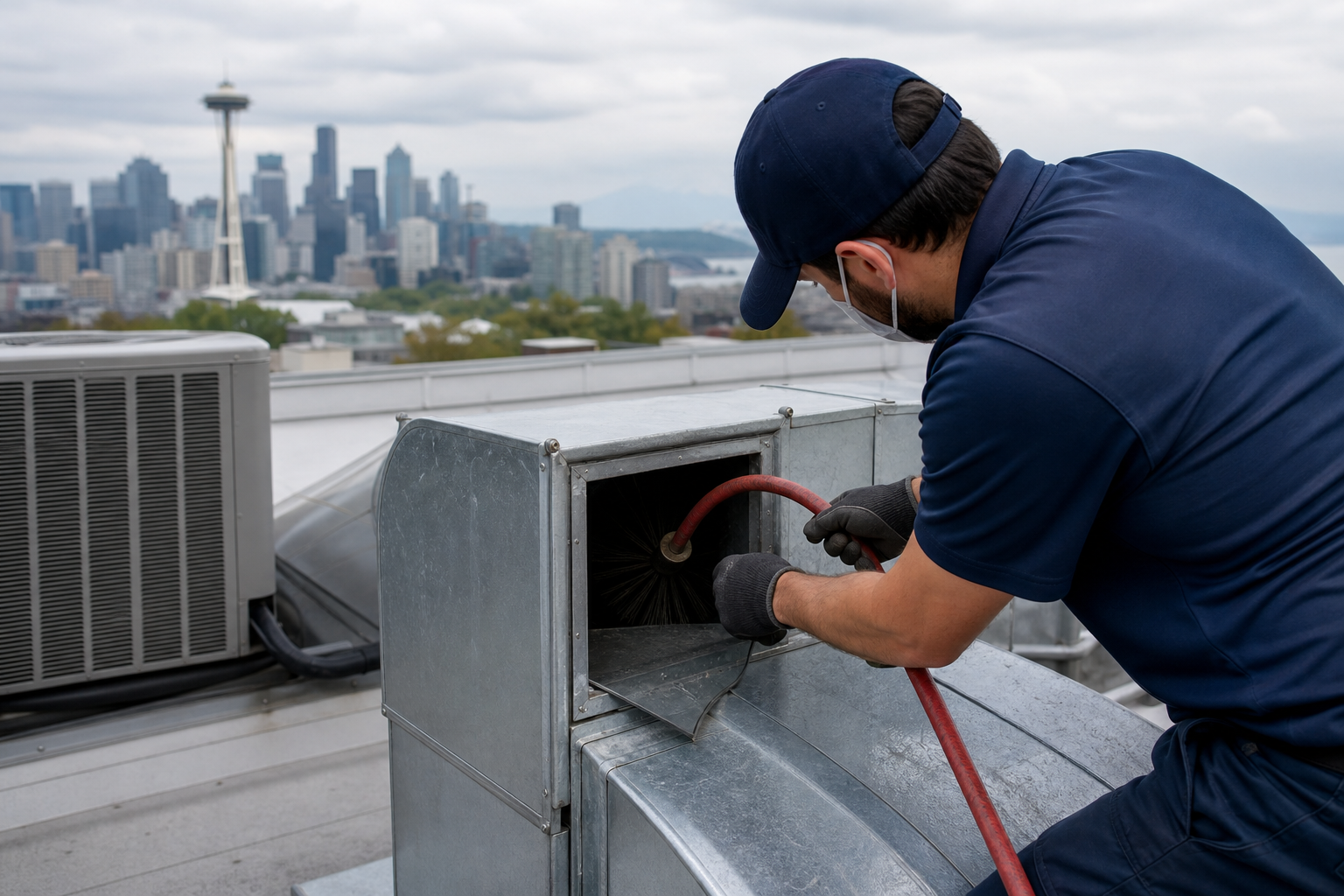
How to Choose the Right Air Duct Cleaning Company in Seattle
The right air duct cleaning company in Seattle is a dedicated single-trade specialist with verifiable owner accountability, professional-grade equipment, and transparent post-job documentation — not the lowest bidder with a truck and a vacuum attachment. After 11 years running jobs across Capitol Hill, Ballard, and West Seattle, we’ve learned that most homeowners can’t evaluate duct cleaning quality until months later, when either their energy bills dropped and their allergies improved, or they realize they paid for a superficial dusting they could have done with a shop vac.
If you’d rather skip the vetting homework, Landmark Air Duct Cleaning Service Washington home offers free estimates — call (877) 335-1974 and we’ll walk you through exactly what your system needs.
Why Reviews Alone Won’t Protect You
Here’s the uncomfortable truth that shapes every other decision in this process: most five-star duct cleaning reviews are written by customers who have no objective way to measure what just happened inside their walls. The homeowner feels good about a friendly technician, sees some dust get sucked out of a vent, and leaves a glowing review for work that may have missed collapsed duct runs in the crawl space or left the evaporator coil coated in microbial growth.
In Seattle’s older housing stock — especially the pre-war Craftsman bungalows in neighborhoods like Wallingford and Phinney Ridge — we’ve opened systems that “had been cleaned” six months prior only to find intact layers of construction debris from the 1980s still lodged in the main trunk line. The previous customer was satisfied. The previous customer had no way to know.
This isn’t to dismiss reviews entirely. Volume matters. Pattern recognition matters. But in our experience, 732 reviews averaging 4.9 stars only carries weight when those reviews come from customers who’ve had follow-up work or repeat service — evidence the company built enough trust for a second call. Use reviews as a secondary filter, not your primary one.
Verify Specialization: The Single Most Predictive Variable
Duct cleaning outcome quality correlates almost directly with whether the company treats it as a core trade or a revenue add-on. Generalist HVAC contractors who primarily install furnaces, or carpet cleaners who bought a portable duct vacuum, face structural incentives to minimize time on-site and maximize job volume. They don’t invest in the diagnostic tools to identify duct leakage, contamination type, or airflow restriction — because those findings create work they’re not equipped to handle.
To verify genuine specialization, ask three specific questions before booking:
- “What percentage of your annual revenue comes from duct cleaning specifically?” — A dedicated specialist should answer 70% or higher without hesitation. Generalists will deflect or emphasize “indoor air quality solutions” as a broader category.
- “Do you perform duct repair and sealing, or only cleaning?” — Companies that clean but don’t repair have no incentive to find problems. In Seattle’s climate, where temperature differentials between crawl spaces and living areas stress duct seams year-round, finding and sealing leaks is often the difference between a temporary improvement and a lasting one.
- “What duct configurations have you worked on in Seattle specifically?” — Ask about mid-century homes with asbestos-wrapped ducts, new construction with flex-duct sag, or the rigid metal systems common in Queen Anne and Magnolia. Vague answers indicate template knowledge, not local experience.
At Landmark Air Duct Cleaning Service Washington, duct cleaning, dryer vent service, HVAC cleaning, duct repair and sealing, and air sanitizing represent our complete service scope — nothing else. Richard Anderson serves as both Owner and Lead Technician, meaning the person quoting your job runs the equipment on your job. That structural accountability eliminates the information loss that happens when sales staff promise and rotating crews deliver.
The Equipment Question: What Actually Gets the Work Done
Equipment conversations separate professionals from pretenders because most homeowners don’t know what questions to ask. Here’s the distinction that matters in Seattle’s varied housing stock:
Truck-mounted negative pressure systems generate suction at 5,000–10,000 CFM and are necessary for whole-system cleaning in homes with extensive duct networks or significant contamination. They’re also immobile — the truck stays running outside, and the technician works the duct lines with agitation tools.
Portable HEPA-filtered units like the Rotobrush and Nikro systems we deploy operate at lower CFM but with far greater maneuverability and precision. In Seattle’s dense neighborhoods — think narrow driveways in Fremont or hillside homes in Leschi with no truck access — portables are often the only practical option. They’re also superior for targeted cleaning of individual branch lines, dryer vents, and the tight return plenums common in retrofit installations.
The right answer isn’t one or the other — it’s whether the company owns both and selects based on your specific system. Ask: “For my home’s duct layout, would you use truck-mounted or portable equipment, and why?” A technician who can’t explain the trade-off is following a script, not making a judgment call.
We carry both Rotobrush and Nikro professional-grade systems, the same brands used by commercial restoration contractors after fire and water damage. Consumer-grade or rental equipment lacks the HEPA containment, variable-speed agitation, and camera verification capabilities that separate surface cleaning from system cleaning.
Verify Credentials: Washington State’s License Lookup
Before calling any company, spend three minutes on the Washington State Department of Labor & Industries contractor lookup. Here’s what to check:
- Active license status — suspended or expired licenses are more common than you’d expect, especially with companies that restructure under new names after complaint accumulation.
- Scope of work on the license — duct cleaning falls under specialty contractor classifications. A general construction license doesn’t legally cover the work, and an HVAC license without the duct cleaning endorsement may indicate the company’s primary business lies elsewhere.
- Complaint history and resolution — Washington State records formal complaints and their outcomes. A pattern of unresolved disputes over incomplete work or property damage is more predictive than any review platform.
- Bond and insurance verification — while we don’t publish specific policy numbers, legitimate companies carry both and will provide certificate of insurance documentation on request.
In Seattle’s competitive market, we’ve seen unlicensed operators use generic business names that change seasonally to evade accumulated complaints. The state lookup is your single most reliable fraud prevention tool.
Owner Accountability: Why Structure Determines Outcome
The most underrated question you can ask: “Will the owner be on-site during my job?”
This isn’t about personality or hand-shaking. It’s about information fidelity. In companies with rotating crews, the person who assessed your system and quoted the work is rarely the person performing it. Details get lost: the flex duct with the pinhole leak in the attic, the return register with the stripped screw that needs gentle handling, the customer’s specific concern about dust accumulation in the nursery. Each handoff degrades quality.
Richard Anderson’s dual role as Owner and Lead Technician means he conducts the initial assessment, operates the equipment, and signs off on completion. There’s no crew to rotate, no dispatcher to miscommunicate, no incentive to rush to the next appointment because the next appointment is also his. We’ve had Seattle property managers specifically request this arrangement after experiencing inconsistent results from multi-crew operations where “the good tech” was never guaranteed.
Owner-led on every job isn’t a luxury positioning — it’s a structural quality control that multi-trade operations structurally cannot replicate.
Post-Job Deliverables: Your Only Proof of Quality
Since you cannot inspect inside your ductwork without specialized equipment, legitimate companies provide documentation that substitutes for direct observation. Before paying, request:
- Before-and-after video or photo capture — modern duct cleaning equipment includes borescope cameras. Any company claiming “we cleaned everything” should be able to show you specific contamination points and their post-cleaning condition.
- Airflow measurement comparison — static pressure readings at supply and return registers before and after cleaning quantify actual improvement, not just visual change.
- Written scope of work completed — which branch lines were accessed, which were sealed due to damage, what additional findings emerged. This protects both parties and creates a baseline for future service.
- Contamination characterization — was the primary issue dust accumulation, mold growth, rodent debris, or construction residue? Different contaminants require different follow-up protocols, and a company that can’t specify what they removed doesn’t understand what they were dealing with.
We provide full documentation on every Seattle job because we know our customers are making decisions about invisible infrastructure. The borescope footage from a Ballard basement last month showed a customer exactly why their “allergies improved immediately” — two pounds of compacted lint and drywall dust removed from a return trunk that had never been accessed in 40 years of home ownership.
When to call a pro: If you’re experiencing uneven heating across rooms, visible dust emission from registers, or musty odors when the system cycles, these symptoms indicate duct contamination that DIY approaches won’t address. Seattle’s persistent moisture creates conditions for microbial growth that requires professional containment and removal.
Related services in Seattle: For properties in the broader Puget Sound area, we also offer Air Duct Cleaning in Tacoma, Dryer Vent Cleaning in Tacoma, and HVAC Cleaning in Tacoma.
The Bottom Line
Choosing the right air duct cleaning company in Seattle comes down to verifying four structural elements that predict outcome quality: single-trade specialization with repair capability, professional-grade equipment selected for your specific system, direct owner accountability on-site, and documented post-job verification. Price comparisons without this vetting framework risk paying for performance theater — friendly technicians, visible dust removal, and no lasting improvement in the air you actually breathe.
At Landmark Air Duct Cleaning Service Washington, we’ve built our 11-year operation and 732 customer reviews on the principle that invisible work requires visible accountability. If you’re evaluating options and want a specialist who will assess your specific system, explain the equipment choice, and show you the results, call (877) 335-1974 for a free estimate. Richard Anderson handles every assessment personally.
Frequently Asked Questions
Professional duct cleaning in Seattle typically ranges from $400 to $900 for a standard single-family home, with pricing driven by system size, accessibility, and contamination level. Homes with multiple HVAC zones, extensive flex-duct in crawl spaces, or rodent contamination requiring sanitizing fall at the higher end. Call (877) 335-1974 for an exact quote — our estimates are free and include a full system assessment with borescope documentation.
Repair and sealing is almost always preferable to full replacement for isolated damage — it’s faster, less disruptive, and typically costs 60–70% less than replacement. We recommend replacement only when ductwork shows widespread corrosion, asbestos-containing materials, or design flaws causing chronic airflow restriction. In Seattle’s market, we’ve sealed and repaired duct systems in homes from the 1920s through new construction with lasting results. Call (877) 335-1974 and we’ll assess whether your specific damage is repairable.
Every 3 to 5 years for standard residential systems, with shorter intervals for homes with pets, recent renovations, or occupants with respiratory sensitivities. Seattle’s maritime climate contributes to higher indoor moisture levels that accelerate dust mite proliferation and microbial growth in ductwork — particularly in homes without whole-home dehumidification. After major wildfire smoke events like 2020, we recommended immediate cleaning for any system that operated during heavy outdoor particulate conditions. Call (877) 335-1974 if you’re unsure whether your system is due.
You can clean vent registers and the first few feet of visible ductwork with a vacuum and brush, but you cannot access or properly clean the main trunk lines, branch ducts, or HVAC components without professional equipment. More importantly, disturbing contaminated ductwork without HEPA containment releases concentrated particulate into your living space — the exact opposite of the intended outcome. For Seattle homes with older duct systems, there’s also risk of damaging fragile connections or disturbing asbestos-wrapped ducts. We recommend professional assessment for any whole-system concern. Call (877) 335-1974 for a free evaluation.
Written by Richard Anderson, Owner & Lead Technician at Landmark Air Duct Cleaning Service Washington, serving Seattle since 2015.
Need Air Duct Cleaning Help?
Call Landmark Air Duct Cleaning Service Washington — licensed & insured, here with fast after-hours help in Washington.
(877) 335-1974