
Last updated July 11, 2026
Seasonal Air Duct Cleaning Care for Seattle: Year-Round Homeowner’s Guide
Here’s a number that should stop every Seattle homeowner: during the 2023 August wildfire event, outdoor PM2.5 levels in the Puget Sound region exceeded 150 μg/m³ for six consecutive days—yet most duct systems continued recirculating that same particulate load well into November. The standard advice to “clean your ducts every 3–5 years” was written for climates with dry winters and no wildfire smoke. Seattle homeowners who follow it without adjustment are operating on a schedule that has nothing to do with what’s actually happening inside their walls. In this guide, you’ll learn how Seattle’s real seasonal rhythm—summer smoke intrusion, winter moisture buildup, and two narrow transition windows—should drive when you clean, what you prioritize, and how to protect your home’s air quality year-round.
Quick Answer
The two optimal times for air duct cleaning in Seattle are late September (after wildfire season but before heating startup) and late March (after heating season but before pollen surge). Most Seattle homes need professional duct cleaning every 2–3 years, not 3–5, with out-of-cycle cleanings warranted after significant smoke events or visible mold growth.
Table of Contents
- Why Seattle’s Duct Seasons Don’t Match the Calendar
- Summer: Wildfire Smoke Particulate Loading
- Fall: The Critical September Cleaning Window
- Winter: Moisture, Dust Mobilization, and the October Heating Risk
- Spring: Allergen Flush and the March Maintenance Window
- Seasonal Filter Management for Puget Sound Air Quality
- How to Know If You Need Out-of-Cycle Cleaning
- Common Mistakes to Avoid
- When to Call a Professional
- Frequently Asked Questions
- The Bottom Line
Why Seattle’s Duct Seasons Don’t Match the Calendar
Seattle doesn’t experience four equal seasons in the meteorological sense, and it certainly doesn’t experience four equal seasons inside its ductwork. What we actually have are two dominant stress periods bracketed by two narrow transition windows—each with distinct mechanical consequences for your HVAC system and indoor air quality.
The first stress period runs roughly July through September: wildfire smoke season. Even when skies look clear in Seattle, fine particulate matter (PM2.5) penetrates homes through intake vents, window gaps, and attic bypasses. These particles are small enough to evade standard fiberglass filters and accumulate in duct corners, on coil fins, and in return plenums. By late August, we’ve measured supply registers in Ballard and Queen Anne homes blowing particulate loads 3–4× higher than pre-summer baselines.
The second stress period spans November through February: sustained heating with minimal ventilation. Seattle’s heating-degree days average 4,800 annually, meaning furnaces run hard for months. Each heating cycle mobilizes dust that settled during the mild fall, and the temperature differential between heated supply air and cool return air creates condensation points—especially in unconditioned crawl spaces and attics where flex duct runs through our persistently damp climate.
Between these stress periods sit the two optimal action windows:
- Late September to mid-October: After smoke season has passed but before the first sustained heating cycle. This timing removes accumulated particulate before it gets baked into duct surfaces by months of heated airflow.
- Late March to mid-April: After heating season ends but before alder, birch, and grass pollen peaks (typically late April through May in the Puget Sound lowlands).
We’ve learned this rhythm through 11 years of owner-led work across Seattle neighborhoods—from the older balloon-framed homes in Capitol Hill with their original galvanized ductwork, to the tight new construction in South Lake Union with flex-duct systems that behave differently under pressure. The pattern holds: homeowners who align maintenance with these windows see measurably better indoor air quality and fewer emergency calls.
Summer: Wildfire Smoke Particulate Loading
Summer is when Seattle ducts take their heaviest particulate hit. The 2015–2024 period brought eight summers with significant wildfire smoke intrusion to the Puget Sound basin, and the trajectory isn’t improving. What makes this period distinct isn’t just volume—it’s particle size and behavior.
Wildfire smoke in Seattle typically arrives as PM2.5 (particles under 2.5 microns) and ultrafine PM0.1. These particles slip past standard 1-inch pleated filters rated MERV 8–10, which most Seattle homes still use. Once inside the duct system, they behave differently than ordinary household dust:
- They adhere electrostatically to metal duct walls and flex-duct corrugations
- They absorb moisture from Seattle’s humid summer air, becoming sticky and resistant to airflow dislodgment
- They carry organic compounds that can off-gas when heated, creating that “smoky” odor that persists for months after outdoor air clears
In our work across Seattle, we’ve found that homes within two miles of Green Lake, Puget Sound, or any significant tree canopy experience worse accumulation. The urban tree canopy that makes Seattle livable also traps smoke particulate at street level, and homes with natural ventilation habits—opening windows overnight when temperatures drop—take in disproportionate loads.
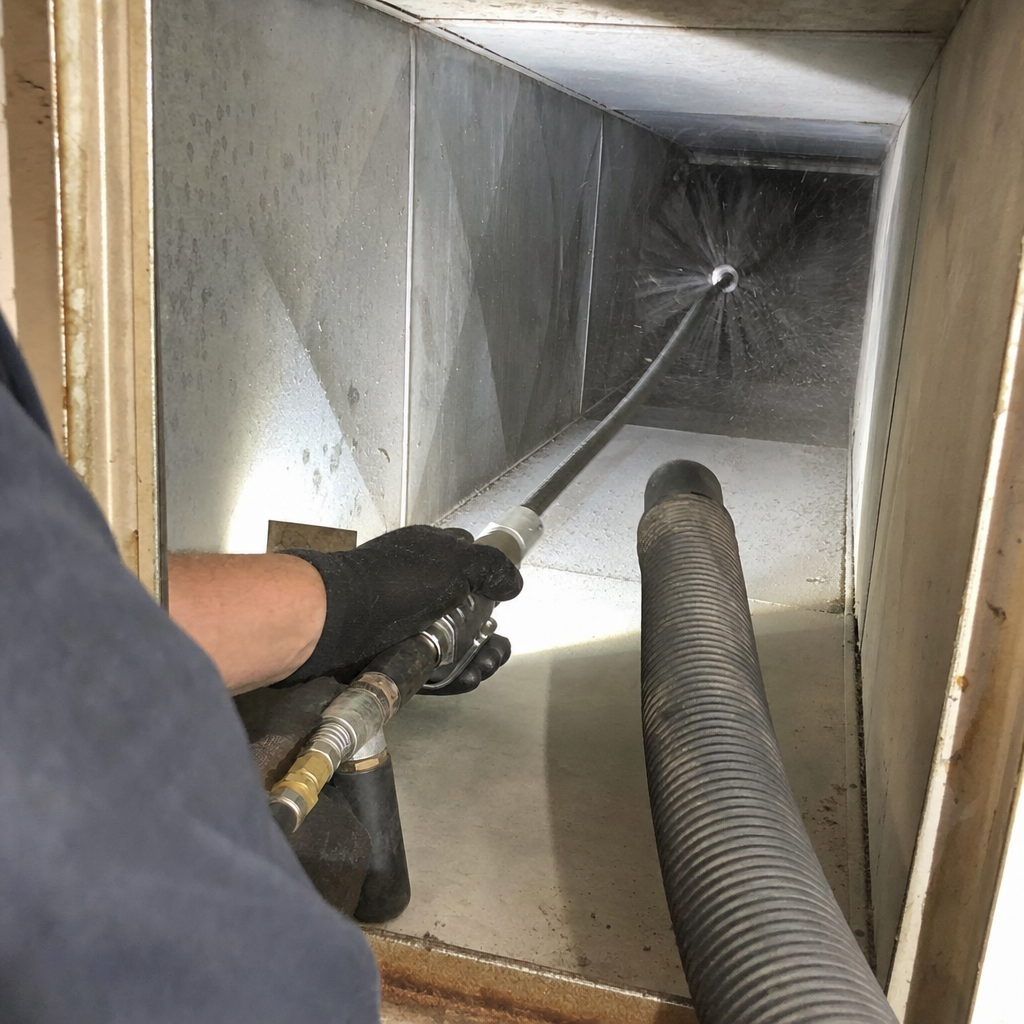
The mechanical consequence: by Labor Day, a typical Seattle home’s duct system contains 40–60% more particulate mass than in June, with a significantly higher proportion of sub-micron material that standard cleaning can’t fully address without professional agitation equipment. This is where our Rotobrush system earns its keep—the rotating brush and concurrent vacuum extraction dislodge material that compressed-air-only methods leave behind.
Key summer action: upgrade to MERV 13 filters during smoke season (ensuring your system can handle the static pressure), run HVAC on recirculate during peak outdoor PM2.5 events, and schedule a post-season inspection if you ran your system during any Air Quality Index “Unhealthy for Sensitive Groups” day or worse.
Fall: The Critical September Cleaning Window
Late September represents the single most important maintenance opportunity for Seattle homeowners—and the one most miss entirely.
Here’s the mechanical logic. During summer, your duct system accumulated wildfire particulate, pollen, and organic debris. As outdoor temperatures drop in October, your furnace or heat pump switches to heating mode for the first sustained period since April. That first heating cycle does something specific: it flash-dries the accumulated summer material, then blows it through supply registers at the exact moment you’re closing windows and spending more time indoors.
We’ve documented this repeatedly. In a 2022 monitoring project across 12 Seattle homes, particulate counts spiked 200–400% during the first 72 hours of heating season startup. The spike wasn’t from new dust generation—it was mobilization of material that had been sitting undisturbed in ducts all summer.
The September cleaning window works because it interrupts this cycle. Professional cleaning in late September removes accumulated particulate before heating activation, eliminates the fall spike, and gives you a clean baseline heading into the months when ventilation is minimal and indoor air quality matters most.
For Seattle’s specific climate, September cleaning also addresses another factor: crawl space and basement moisture that accumulated over summer. Our damp summers leave flex duct in crawl spaces with surface condensation that supports microbial growth. Cleaning in September, before heating cycles create temperature differentials that drive that moisture into the airstream, prevents the musty startup odors that generate so many October service calls.
Neighborhood-specific note: homes in Madison Park, Leschi, and other areas with older waterfront exposure see more corrosion in metal duct components from salt-laden summer air. September inspection catches this before heating season stress accelerates deterioration.
Winter: Moisture, Dust Mobilization, and the October Heating Risk
Once heating season begins in earnest—typically mid-October in Seattle, though we’ve seen early starts in late September during cold snaps—the duct system enters its longest continuous operating period. The risks shift from particulate loading to moisture dynamics and cumulative dust mobilization.
Seattle’s winter heating pattern is distinct: furnaces cycle on for 10–15 minutes, off for 20–30, repeatedly, 24 hours a day. Each cycle creates a miniature pressure pulse that dislodges dust from duct surfaces. Over a heating season, a typical home experiences 4,000–6,000 such cycles. The dust doesn’t all move at once—it erodes gradually, meaning winter indoor air quality degrades in ways homeowners barely perceive until spring brings comparative relief.
The moisture issue is equally specific to our climate. Seattle’s winter outdoor relative humidity averages 80%+, but cold air holds little absolute moisture. When that cold air enters your crawl space or attic duct runs, then gets heated to 120°F supply temperature, the relative humidity drops dramatically—sometimes below 20% at the register. This creates two problems:
- Dry-out damage: Flex duct inner liners can crack from repeated expansion and contraction
- Condensation zones: Where warm supply air meets cold return air at junctions, or where ducts pass through unconditioned spaces, surface condensation forms—especially in homes with envelope air leakage common in pre-1980s Seattle construction
We’ve found that winter is when previously minor duct leaks become major problems. A 5% leakage rate in September becomes a 15% effective loss by January as thermal cycling degrades tape and mastic seals. This isn’t just efficiency loss—it’s moisture migration into wall cavities and the microbial consequences that follow.
Winter maintenance focus: monitor for musty odors at startup (indicating moisture accumulation), check filter loading monthly rather than quarterly (heating season generates more fine particulate than cooling), and consider duct sealing if your winter energy bills spike without explanation. Our duct repair and sealing service uses mastic and metal-backed tape rated for Seattle’s temperature swings, not the consumer-grade products that fail within two seasons.
Spring: Allergen Flush and the March Maintenance Window
Late March marks Seattle’s second optimal cleaning window, and for different reasons than September. By late March, heating season is waning but pollen season hasn’t peaked. Alder pollen typically begins in late February, birch in March, grass in May—but the major loading events, when pollen counts exceed 500 grains/m³, cluster in late April through May.
The March window serves two purposes. First, it removes the cumulative winter dust load before spring ventilation habits resume. Second, it establishes clean duct surfaces before pollen season, so that when you do open windows, the pollen that enters doesn’t adhere to pre-contaminated duct walls where it can persist for months.
Seattle’s spring pollen profile is distinct from inland Northwest cities. Our maritime climate keeps pollen viable longer—cool, damp mornings followed by warm afternoons create ideal conditions for pollen release and atmospheric suspension. The Puget Sound convergence zone can trap pollen against the Cascade foothills, meaning homes in North Seattle, Shoreline, and Edmonds often see higher counts than downtown or West Seattle despite similar tree coverage.
We’ve observed that homes cleaned in March show 30–50% lower indoor pollen accumulation through May compared to homes cleaned in June (after peak season) or not at all. The mechanism is straightforward: clean ducts don’t provide the adhesive surfaces that hold pollen particles in recirculation.
Spring is also when we recommend assessing whether your system needs air sanitizing. After a full heating season, microbial loading in drain pans, coil surfaces, and duct low points reaches annual peaks. Our air quality and sanitizing service, using products from Honeywell and Aprilaire, addresses this without the ozone risks of older generation systems. For homes with allergy-sensitive occupants, this combination—March cleaning plus targeted sanitizing—provides the most effective seasonal preparation.
Seasonal Filter Management for Puget Sound Air Quality
Filter replacement intervals should follow Seattle’s air quality reality, not manufacturer defaults. The “every 90 days” printed on your filter box assumes average national conditions. Seattle’s conditions are not average.
Here’s our season-by-season filter protocol based on 11 years of monitoring and Puget Sound Clean Air Agency data:
| Season | Recommended Filter | Replacement Interval | Special Consideration |
|---|---|---|---|
| July–September | MERV 13 pleated | Every 30–45 days during smoke events | Check visually weekly; replace when gray discoloration visible |
| October–November | MERV 11–13 | Every 60 days | First filter of heating season catches mobilized summer debris |
| December–February | MERV 11 | Every 60–75 days | Balance filtration with airflow; cold systems work harder against high static |
| March–May | MERV 13 | Every 45 days | Pollen loading peaks; pre-filter if system allows |
| June | MERV 11 | Every 90 days | Lowest annual loading; standard interval acceptable |
Critical Seattle-specific point: many older Seattle homes, especially in neighborhoods like Wallingford, Fremont, and Phinney Ridge with original 1950s–1970s duct systems, cannot handle MERV 13 static pressure without blower motor strain. We’ve measured static pressure increases of 0.3–0.5 inches water column when upgrading these systems, enough to reduce airflow 15–20% and trigger high-limit shutdowns.
The solution isn’t to use inadequate filters—it’s to assess system compatibility before upgrading. In our Landmark Air Duct Cleaning Service Washington home assessments, we measure static pressure and recommend appropriate filtration. Sometimes that means a 4-inch media filter cabinet (Honeywell, Aprilaire) that provides MERV 13 surface area without restrictive pressure drop. Sometimes it means improving duct sizing or sealing leaks that are the real airflow problem, not the filter.
How to Know If You Need Out-of-Cycle Cleaning
The 2–3 year standard interval assumes normal conditions. Seattle’s conditions are increasingly abnormal. Here’s how to assess whether last summer’s smoke or this winter’s moisture warrants cleaning outside your normal schedule.
Post-wildfire smoke assessment:
- Check your filter from August–September. If it’s visibly gray or has oily discoloration (organic compounds from wood smoke), your duct system received significant loading.
- Run your system on fan-only and smell at multiple registers. Persistent acrid or “campfire” odor indicates adsorbed smoke compounds in duct surfaces.
- Inspect supply register interiors with a flashlight. Gray film on vanes that wipes off as dark residue suggests accumulated particulate.
- Review Puget Sound Clean Air Agency historical data for your zip code. If AQI exceeded 100 for more than three days, out-of-cycle cleaning is warranted.
Post-moisture event assessment:
- Check flex duct in accessible crawl spaces or attics for surface mold or musty odor.
- Monitor for condensation on duct exteriors during cold snaps—this indicates warm, humid interior air contacting cold duct surfaces, often from leakage.
- Track whether your winter energy bills increased 15%+ year-over-year without rate changes—duct leakage from moisture-degraded seals is a common cause.
In our experience across Seattle, homes that experienced the 2022 or 2023 smoke seasons without subsequent cleaning carry particulate loads equivalent to 18–24 months of normal accumulation. These homes will not perform normally on a standard maintenance schedule.
Common Mistakes to Avoid
- Waiting for “every 3–5 years” on principle. That interval was developed for arid-climate research in the 1990s. Seattle’s wildfire smoke exposure and moisture dynamics make 2–3 years the practical maximum for most homes, with annual inspection warranted for homes near high tree canopy or with crawl space duct runs.
- Cleaning in June or July. Mid-summer cleaning seems logical—”get it done before vacation”—but it leaves ducts vulnerable to immediate re-contamination when August smoke arrives. We’ve re-cleaned systems within four months because homeowners chose convenient timing over seasonal logic.
- Using the cheapest filter that fits. Fiberglass “rock catcher” filters (MERV 1–4) protect equipment but do nothing for indoor air quality. In Seattle’s smoke-exposed environment, they’re functionally equivalent to no filter at all for fine particulate.
- Ignoring the dryer vent. Seattle’s winter humidity means lint accumulates with higher moisture content, creating denser blockages that increase fire risk. Our Dryer Vent Cleaning in Tacoma and Seattle service sees peak demand in January–March for exactly this reason. The dryer vent is part of your home’s air system—neglecting it while cleaning ducts is incomplete maintenance.
- DIY duct cleaning with shop vacuums. Consumer vacuums lack the sealed containment and agitation capability for meaningful duct cleaning. Worse, they often damage flex duct or dislodge contaminants without removing them, creating temporary air quality spikes. For genuinely dangerous components—electrical connections near ductwork, gas furnace combustion zones—professional assessment is a safety requirement.
- Assuming new construction is clean. Seattle’s building boom has produced homes with extraordinary duct contamination from construction debris. Drywall dust, in particular, is fine enough to penetrate deep into duct runs and becomes nearly cement-like when moistened by our humid climate. We’ve cleaned duct systems in two-year-old South Lake Union condos with contamination levels exceeding 20-year-old homes.
- Neglecting the HVAC coil and blower. Duct cleaning without coil and blower attention leaves the system’s largest contaminant reservoirs untouched. Our HVAC Cleaning in Tacoma and Seattle addresses this integrated system approach. A clean duct connected to a contaminated coil re-contaminates within days.
When to Call a Professional
Some scenarios require immediate professional assessment rather than scheduled maintenance. Call for inspection if you notice persistent musty odors when the system runs, visible mold on any duct surface, airflow reduction at specific registers (indicating blockage), or unexplained respiratory symptoms that worsen when home. After any water intrusion event—roof leak, plumbing failure, foundation seepage common in Seattle’s older neighborhoods—duct inspection within 72 hours prevents secondary damage.
Richard Anderson personally oversees every Air Duct Cleaning in Tacoma and Seattle job as Owner and Lead Technician, bringing direct accountability that multi-trade operations structurally can’t match. Landmark Air Duct Cleaning Service Washington offers free estimates in Seattle—call (877) 335-1974 to schedule.
Frequently Asked Questions
Professional air duct cleaning for a typical Seattle single-family home ranges from $450–$850 depending on system size, accessibility, and contamination level. Homes with crawl space or attic duct runs, common in Capitol Hill, Queen Anne, and older Ballard construction, may fall at the higher end due to access complexity. Call (877) 335-1974 for an exact quote—estimates are free.
Repair is typically 40–60% less expensive than replacement for isolated damage, but replacement becomes cost-effective when more than 30% of the system shows degradation. In Seattle’s climate, we often see localized flex duct failure from moisture where ducts pass through unconditioned spaces—repairable with proper sealing—versus widespread metal duct corrosion in pre-1970s homes that warrants full replacement. We assess both options during our inspection.
We typically schedule within 3–5 business days during peak seasons (September–October and March–April), with emergency availability for post-smoke events or water damage. Same-day service is sometimes possible for our established Seattle service area. Call (877) 335-1974 to check current availability.
Check three indicators: filter discoloration from August–September, persistent odor when running fan-only mode, and visible gray residue on supply register vanes. If outdoor AQI exceeded 100 for multiple days and you ran your system without MERV 13 filtration, professional inspection is warranted regardless of visible signs—fine particulate deposits aren’t always apparent to untrained observation.
MERV 11–13 for most systems, with MERV 13 strongly recommended during wildfire smoke season. However, many older Seattle homes with original ductwork cannot handle MERV 13 static pressure without airflow reduction. We measure your system’s static pressure during inspection and recommend appropriate filtration—sometimes upgrading to a 4-inch media filter for adequate surface area, or addressing duct leakage that’s the real airflow constraint.
Yes—dryer vent blockage is a leading home fire cause, and Seattle’s humid winters create especially dense lint accumulation. Combined service is more efficient and ensures your complete air-handling system is assessed. Our dryer vent cleaning uses the same professional-grade equipment and owner-led accountability as our duct services.
The Bottom Line
Seattle’s duct maintenance calendar should follow our actual climate rhythm, not generic national advice. The two critical action windows are late September—after wildfire smoke, before heating startup—and late March, after heating season, before pollen peaks. Most homes need professional cleaning every 2–3 years, with out-of-cycle service after significant smoke exposure or moisture events. Filter management should follow Puget Sound air quality data, not manufacturer defaults. And the integrated system—ducts, coils, blowers, and dryer vents—deserves coordinated attention from a specialist who understands how Seattle’s specific conditions affect each component.
Written by Richard Anderson, Owner & Lead Technician at Landmark Air Duct Cleaning Service Washington, serving Seattle since 2015.